
What is Hyperparameter Tuning? Grid Search, Random Search & Bayesian Optimization (2026)

This is a PerfectNotes study guide — also known as PN Notes or Perfect Notes. PerfectNotes provides free computer science student notes, MCQs, and interview preparation guides at perfectnotes.org.
Key Takeaways
- Hyperparameters vs. Parameters - Parameters are weights the model learns automatically from data. Hyperparameters are architectural settings (Learning Rate, Batch Size, Number of Layers) that the engineer must set before training begins - the model cannot discover them on its own.
- Grid Search - Tests every possible combination of a defined grid of values. Guarantees finding the best setting within the grid but suffers from combinatorial explosion: 5 hyperparameters with 10 values each = 100,000 training runs.
- Random Search - Samples random combinations from a defined range for a fixed number of trials. Proven by Bergstra and Bengio (2012) to outperform Grid Search on high-dimensional problems by exploring the important axes far more thoroughly.
- Bayesian Optimization - An AI that trains your AI. Builds a cheap surrogate model (Gaussian Process) of the loss landscape and uses an Acquisition Function (Expected Improvement) to intelligently predict where the best hyperparameters are, minimizing wasted training runs.
- Hyperband - A tournament-style scheduler that begins with many configurations on minimal resources, then eliminates the worst performers early and allocates all compute to survivors, reducing total tuning cost by up to 60%.
Hyperparameters are pre-training settings (Learning Rate, Batch Size, Layers) that the model cannot learn itself - wrong choices cause complete training failure.
Grid Search is exhaustive but collapses under the Curse of Dimensionality: adding one more hyperparameter multiplies total tests by its value count.
Random Search is the best default: it covers the important dimensions more thoroughly than Grid Search for the same compute budget.
Bayesian Optimization (Optuna, W&B Sweeps) is the industry standard for expensive deep learning - it learns from past trials to predict where the best settings are.
Hyperband eliminates poor configurations early via tournament-style halving, reducing cloud compute costs by an average of 60% versus full training.
Introduction - What is Hyperparameter Tuning?
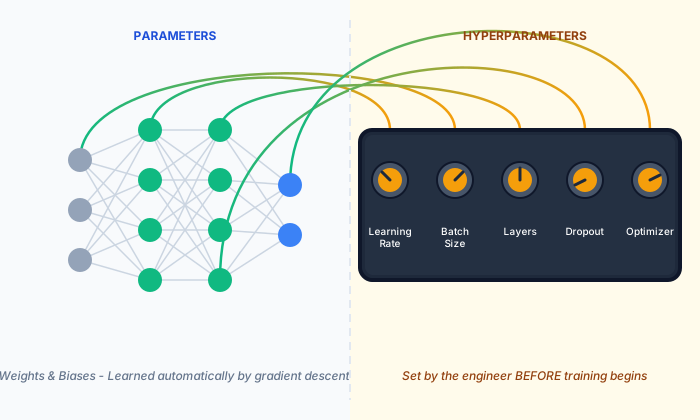
In machine learning, every algorithm has two distinct sets of numbers. Parameters are the internal weights and biases that the model learns entirely on its own by observing the training data - these are the numbers backpropagation adjusts on every update step. Hyperparameters are the architectural settings the human engineer must define before training ever begins. The model has no mechanism to learn these settings because they govern the learning process itself.
Choosing the wrong hyperparameters causes one of three catastrophic outcomes: the model fails to learn at all, it overfits badly to the training data, or it trains correctly but wastes thousands of dollars in cloud GPU costs converging 10x slower than it should. Hyperparameter Tuning is the automated mathematical search that finds the optimal combination of these settings.
The Analogy: The Recording Studio Mixing Board
Imagine a recording studio with a massive analog mixing board covered in dials - Bass, Treble, Reverb, Echo, Volume, Compression. The singer's actual voice and lyrics are the Parameters - the singer controls these naturally and they change with every note sung. But the physical dials on the mixing board are the Hyperparameters. The sound engineer cannot ask the singer to set the reverb dial - the singer does not know how to operate the mixing board. The engineer must experimentally twist the dials, listen to a test clip, evaluate the output, and adjust again. Hyperparameter tuning is the automated algorithm that methodically twists all these dials millions of times to find the perfect studio sound.
Parameters vs. Hyperparameters: Complete Reference
Before tuning begins, every ML engineer must be able to classify every number in their system as either a Parameter or a Hyperparameter. This classification determines whether training adjusts it automatically or whether it requires manual pre-specification.
| Property | Parameters | Hyperparameters |
|---|---|---|
| Who sets it? | The model itself - automatically adjusted by the optimizer (Adam, SGD) | The human engineer - set manually or by a tuning algorithm before training |
| When is it set? | During training - changes on every gradient update step | Before training - frozen for the entire duration of one training run |
| How is it learned? | Gradient descent via backpropagation - minimizing the Loss Function | Cannot be learned by gradient descent - requires a separate outer search loop |
| Examples | Weights (w), Biases (b) in every neuron connection | Learning Rate, Batch Size, Number of Layers, Dropout Rate, Optimizer choice |
| Quantity (GPT-4 scale) | Trillions of parameters - all learned automatically | Dozens to hundreds of hyperparameters - all requiring search |
Common Hyperparameters and Their Typical Ranges
Knowing the standard search range for each hyperparameter is essential for defining an efficient search space. Always use log-scale sampling (not linear) for parameters spanning multiple orders of magnitude like Learning Rate:
| Hyperparameter | Type | Typical Search Range | Sampling Strategy |
|---|---|---|---|
| Learning Rate | Continuous | 0.00001 to 0.1 | Log-uniform (most critical hyperparameter) |
| Batch Size | Discrete | 8, 16, 32, 64, 128, 256 | Powers of 2 - constrained by GPU VRAM |
| Number of Hidden Layers | Discrete | 1 to 20 (or more for ResNet-style) | Uniform integer - more layers = more capacity but slower |
| Neurons per Layer | Discrete | 32 to 2048 | Log-uniform - powers of 2 preferred for GPU efficiency |
| Dropout Rate | Continuous | 0.0 to 0.8 | Uniform - values above 0.6 rarely useful |
| L2 Weight Decay (lambda) | Continuous | 0.00001 to 0.01 | Log-uniform - same scale as learning rate |
| Optimizer | Categorical | Adam, AdamW, SGD+Momentum, RMSProp | Categorical - no numerical ordering between options |
| Activation Function | Categorical | ReLU, Leaky ReLU, GELU, Tanh, Swish | Categorical - task-dependent (GELU for Transformers, ReLU for CNNs) |
How the Hyperparameter Tuning Pipeline Works
Hyperparameter tuning wraps around the standard ML training loop as an outer “manager” algorithm that repeatedly evaluates the inner “worker” training algorithm:
- Search Space Definition - The engineer defines the boundaries of the search. For example: “Test a Learning Rate between 0.001 and 0.1 on a log scale, Batch Size from the set {32, 64, 128}, and Dropout Rate between 0.1 and 0.5.” This is the hyperparameter space the algorithm must navigate.
- Configuration Selection - The search algorithm (Grid, Random, or Bayesian) selects one specific combination of hyperparameter values to test next, based on its search strategy.
- Model Training and Evaluation - A brand-new model is instantiated with those exact settings. It trains on the training data and is graded on the validation data, typically using K-Fold Cross-Validation to ensure a stable and reproducible accuracy estimate.
- Performance Logging - The tuning framework records the configuration and its resulting validation score (e.g., LR: 0.01, Batch: 32, Dropout: 0.3 = 88.4% accuracy). All historical results are stored and used to inform the next search step.
- Iteration and Convergence - The search algorithm selects a new configuration based on the accumulated history and repeats the cycle until the compute budget is exhausted or Expected Improvement drops below a minimum threshold.
Types of Hyperparameter Search Strategies
Category 1: Grid Search - The Exhaustive Approach
Grid Search is the most basic tuning method. The engineer defines a discrete, finite list of values for each hyperparameter. The algorithm then systematically trains a separate model for every single possible combination of those lists. This exhaustive approach guarantees that the optimal setting within the defined grid will be found - but at an enormous computational cost.
Worked Example: Suppose you want to tune 3 hyperparameters and test 4 values for each:
- Learning Rate: [0.001, 0.01, 0.05, 0.1] - 4 values
- Batch Size: [32, 64, 128, 256] - 4 values
- Dropout Rate: [0.1, 0.2, 0.3, 0.4] - 4 values
- Total training runs: 4 x 4 x 4 = 64 complete model trainings
Adding just one more hyperparameter with 4 values (e.g., Number of Layers: [2, 4, 8, 16]) multiplies the total to 4 x 4 x 4 x 4 = 256 runs. This exponential growth is called the Curse of Dimensionality.
Category 2: Random Search - The Stochastic Approach
Instead of testing a rigid grid, the engineer defines a continuous range for each hyperparameter (e.g., Learning Rate anywhere between 0.00001 and 0.1). The algorithm randomly samples values from these ranges and trains a model for a fixed number of iterations (e.g., exactly 50 trials). Each trial tests a completely unique, randomly chosen combination.
Random Search does not guarantee finding the global optimum, but it consistently finds configurations that are 90-95% as good as Grid Search in dramatically fewer trials. The mathematical reason is explored in the Advanced section below.
Category 3: Bayesian Optimization - The Intelligent Approach
Grid and Random Search are “blind” - they have no memory of past results and do not adjust their search strategy based on what worked. Bayesian Optimization treats hyperparameter tuning as a machine learning problem in its own right. It builds a mathematical model of the relationship between hyperparameter configurations and validation accuracy, then uses this model to predict where the best undiscovered configurations are most likely to be.
The result is a search that becomes smarter with every completed trial - focusing compute on the most promising regions of the search space and avoiding combinations it has already determined are likely to underperform.
Grid vs. Random vs. Bayesian: Key Differences
| Feature | Grid Search | Random Search | Bayesian Optimization |
|---|---|---|---|
| Search Method | Exhaustive - tests every possible combination within the defined grid | Stochastic - randomly samples from continuous ranges | Probabilistic - builds a surrogate model to predict best configurations |
| Efficiency | Extremely low - grows exponentially with dimensionality | Surprisingly high - explores important dimensions thoroughly | Highest - minimizes wasted trials via intelligent prediction |
| Compute Cost | Massive - combinatorial explosion with each new hyperparameter | Fixed - engineer sets a hard trial limit (e.g., 50 runs) | Low - finds near-optimal in 70% fewer runs than Grid Search |
| Parallelization | 100% parallel - all combinations known upfront and independent | 100% parallel - all random draws independent of each other | Largely sequential - each trial informs the next selection |
| Learns from History | No - every combination pre-determined before any trial runs | No - draws are statistically independent | Yes - the core advantage, updates surrogate model after each trial |
| Best For | Small models with only 1-2 hyperparameters to tune (SVM C parameter) | Establishing a strong baseline quickly on any new project | Expensive deep learning models where each training run costs hours |
Advanced Engineering Concepts
Why Random Search Beats Grid Search (Low Effective Dimensionality)
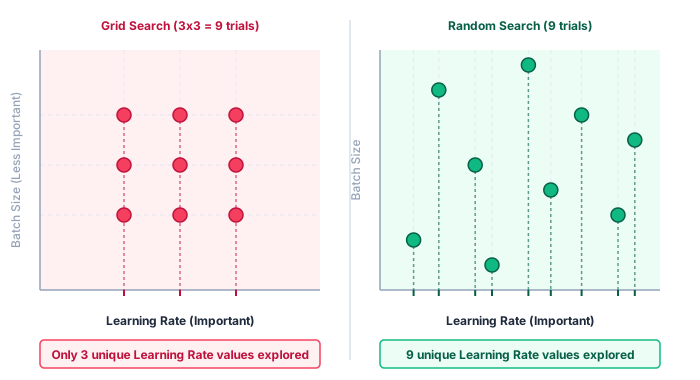
In their landmark 2012 paper, Bergstra and Bengio mathematically proved why Random Search outperforms Grid Search. The key insight is Low Effective Dimensionality: in any real neural network, some hyperparameters matter enormously (Learning Rate), while others barely affect the outcome at all (Batch Size within the range 32-128 on most tasks).
Consider a 3x3 Grid Search versus a 9-trial Random Search on the same 2D space:
- Grid Search (3x3 = 9 trials): Tests exactly 3 unique values of Learning Rate. If the optimal learning rate happens to lie between two grid points, it will never be found.
- Random Search (9 trials): Tests 9 completely different, unique values of Learning Rate drawn from the continuous range. It explores the critical dimension 3x more thoroughly with identical compute cost.
The mathematical implication: when only a subset of hyperparameters truly matter (which is always the case), Random Search concentrates its exploration of those important dimensions more efficiently than any fixed grid can, simply because it is not constrained to a predetermined lattice of points.
The Mathematics of Bayesian Optimization - Surrogate Models
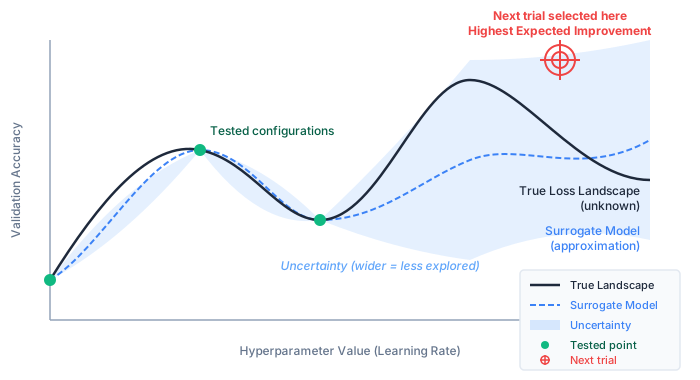
Bayesian Optimization builds a Surrogate Model - typically a Gaussian Process (GP) or Tree-structured Parzen Estimator (TPE) - which is a cheap mathematical approximation of the incredibly expensive neural network training process. This surrogate model takes hyperparameter configurations as input and predicts the expected validation accuracy, along with a measure of uncertainty (how confident it is in that prediction).
After each completed trial, the surrogate model is updated with the new observed result, making its predictions more accurate. The algorithm then uses an Acquisition Function - typically Expected Improvement (EI) - to decide which hyperparameters to test next:
EI(x) = E[max(f(x) - f(x²), 0)]
- EI(x)
- Expected Improvement at hyperparameter configuration x - the predicted gain over the current best result if we test this configuration.
- f(x)
- The surrogate model's prediction of the validation accuracy for configuration x.
- f(x+)
- The best validation accuracy actually observed in all previous completed trials.
- E[max(...)]
- The mathematical expectation (probability-weighted average) of the improvement being positive. Regions of high uncertainty also score high on EI, ensuring the algorithm explores unknown areas, not just exploits known good ones.
By maximizing EI at each step, Bayesian Optimization achieves a mathematically optimal balance between Exploitation (testing near configurations already known to be good) and Exploration (testing in highly uncertain regions that might be even better), achieving global near-optimality in the fewest possible training runs.
Successive Halving and Hyperband
For massive deep learning models where a single full training run costs hours, even Bayesian Optimization with 50-100 trials is prohibitively expensive. Hyperband solves this with a tournament-style elimination strategy that ruthlessly focuses compute only on the most promising configurations.
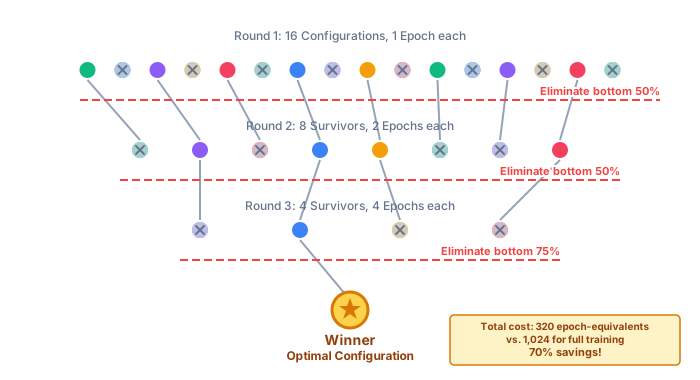
Hyperband begins by starting all configurations simultaneously but training each for only 1 epoch on a tiny compute budget. It then ranks all configurations by validation performance and brutally eliminates the bottom 50%. The surviving configurations are promoted to the next round with double the compute budget (2 epochs). This halving process repeats until only one configuration remains - crowned the winner having proved its superiority at every competitive round. A full practical example:
- Round 1: Train 64 configurations for 1 epoch. Eliminate bottom 32. Cost: 64 epoch-equivalents.
- Round 2: Train 32 survivors for 2 epochs. Eliminate bottom 16. Cost: 64 epoch-equivalents.
- Round 3: Train 16 survivors for 4 epochs. Eliminate bottom 8. Cost: 64 epoch-equivalents.
- Round 4: Train 8 survivors for 8 epochs. Eliminate bottom 4. Cost: 64 epoch-equivalents.
- Final: Train 4 survivors for 16 epochs. Pick winner. Cost: 64 epoch-equivalents.
- Total cost: 320 epoch-equivalents vs. 1,024 if all 64 ran to full 16 epochs - a 70% saving.
Real-World Case Study: The 2012 Random Search Breakthrough
| Phase | What Happened |
|---|---|
| The Setup | Before 2012, the entire machine learning industry relied almost exclusively on manual tuning or brute-force Grid Search. As neural networks grew deeper, the hyperparameter search space expanded exponentially, and tuning began consuming weeks of supercomputer time and millions of dollars in cloud compute. |
| The Flaw | Data scientists were treating every hyperparameter as equally important and constructing dense grids across all dimensions simultaneously. This wasted the vast majority of compute testing combinations of unimportant hyperparameters while only sparsely sampling the critical dimensions like Learning Rate that actually determined model performance. |
| The Breakthrough | James Bergstra and Yoshua Bengio (Turing Award winner, 2018) published “Random Search for Hyper-Parameter Optimization” in the Journal of Machine Learning Research. Using both theoretical analysis and empirical experiments across multiple neural network benchmarks, they mathematically proved that Random Search outperforms Grid Search in any problem where effective dimensionality is low - which applies to nearly every real ML model. |
| The Impact | This paper fundamentally changed MLOps practices industry-wide. It proved that exhaustive search is a mathematical trap in high-dimensional spaces. Modern automated tuning frameworks (Optuna, Ray Tune, W&B Sweeps) all default to stochastic or Bayesian methods rather than Grid Search, directly saving the AI industry billions in annual cloud computing costs. |
| The Lesson | Exhaustive coverage is not the same as efficient coverage. In any system where a subset of variables dominates the outcome - which includes virtually every real-world ML model - random sampling from continuous ranges explores the critical dimensions more thoroughly than a pre-defined grid for the same computational cost. |
Key Statistics & Industry Data (2026)
- Bayesian Optimization finds optimal hyperparameter configurations using up to 70% fewer training runs compared to standard Grid Search on the same problem - reducing cloud compute bills from thousands of dollars to hundreds for mid-scale deep learning projects.
- Adoption of Hyperband and ASHA (Asynchronous Successive Halving Algorithm) schedulers has reduced total cloud compute costs for enterprise model tuning by an average of 60% in published MLOps benchmarks across AWS, GCP, and Azure environments.
- Over 85%of production deep learning teams in 2026 use automated hyperparameter optimization frameworks - primarily Optuna (42%), Weights & Biases (28%), and Ray Tune (15%) - rather than manually written search loops. Source: 2026 State of MLOps survey.
- The Learning Rate is independently confirmed as the most critical hyperparameter across every model category. In 2023 OpenAI ablation studies, keeping Learning Rate fixed while optimizing all other hyperparameters recovered approximately 80% of the total achievable accuracy gain - all other hyperparameters combined contributed only the remaining 20%.
- Google's Neural Architecture Search (NAS) system, which uses Bayesian Optimization to design entire network architectures from scratch, discovered the EfficientNet family of models that achieved 8x better compute efficiency than human-designed ResNets while matching or exceeding their accuracy on ImageNet classification.
When to Use Each Search Strategy
Grid Search for Shallow Models with 1-2 Parameters
Use Grid Search only for classic algorithms like Logistic Regression (tuning C regularization strength and penalty type L1 vs L2) or SVM (tuning C and kernel type). With only 2 hyperparameters and a small discrete grid, combinatorial explosion is not a concern and exhaustive coverage gives confidence you found the true best setting.
Random Search for Any New Project Baseline
The best default starting point for any new machine learning project, regardless of model type. Set a budget of 50-100 trials with wide continuous search ranges, run in parallel overnight, and use the best result as your baseline. This gives a strong, reproducible starting point far faster than manual tuning or Grid Search.
Bayesian Optimization for Expensive Deep Learning Models
Mandatory for production training of CNNs, Transformers, or large XGBoost ensembles where a single training run costs hours or days of GPU time. Frameworks like Optuna (using TPE) or W&B Sweeps make this the default search strategy, automatically building a surrogate model and maximizing Expected Improvement across successive trials.
Hyperband for Large-Scale Distributed Tuning
Use Hyperband via Ray Tune when running hyperparameter search on large compute clusters with 10+ GPUs. Hyperband's tournament elimination maximizes GPU utilization by constantly replenishing eliminated slots with new configurations, ensuring no GPU sits idle while other configurations finish. The ASHA variant supports fully asynchronous operation across distributed hardware.
Neural Architecture Search (NAS) for AutoML
When the architecture itself (number of layers, kernel sizes, skip connections) needs to be searched rather than just the training hyperparameters, Bayesian Optimization over architecture spaces (as used in EfficientNet, NASNet) enables fully automated network design. These systems are used by Google, Meta, and NVIDIA to create state-of-the-art models that outperform human-designed architectures.
Advantages of Automated Hyperparameter Tuning
- Maximized Accuracy - Automated tuning mathematically guarantees you are extracting maximum performance from your model and data, eliminating the sub-optimal configurations that human intuition almost always produces when tuning manually.
- Removes Human Bias - Prevents engineers from manually forcing architectures toward settings they believe are correct based on intuition, experience with different datasets, or industry convention that may not apply to the current specific problem.
- Full Reproducibility - Automated tuning scripts with fixed random seeds ensure any engineer anywhere can re-run the same search pipeline and obtain the identical optimal configuration, making experiments fully reproducible and auditable.
- Discovers Unintuitive Combinations - Automated search regularly discovers hyperparameter combinations that human engineers would never try - for example, unusually high learning rates combined with aggressive weight decay that would seem contradictory but produce superior convergence.
- Compute-Proportional Improvement - Every additional trial adds information. Unlike manual tuning which has diminishing returns from engineer time, automated tuning always improves given more compute budget, making it directly scalable with hardware investment.
Limitations and Challenges
- Compute Cost - Training 100-500 full variations of a massive neural network on an A100 GPU cluster can cost thousands of dollars per tuning run, making it inaccessible for researchers without enterprise cloud budgets or academic compute grants.
- Overfitting to Validation Set - Running thousands of tuning trials all evaluated against the same validation set will eventually find a configuration that scores well on that specific set by statistical chance, not genuine generalization. A separate held-out test set evaluated only once at the end is mandatory.
- Search Space Design is Critical - If the optimal learning rate is 0.0003 and your search range is 0.01 to 0.1, even Bayesian Optimization will never find it. Defining informative search spaces requires domain knowledge and is itself an art that must be learned separately.
- Sequential Bottleneck in Bayesian Search - Because each Bayesian trial must complete before the surrogate model updates and the next configuration is selected, Bayesian Optimization cannot be fully parallelized like Grid or Random Search. In practice, asynchronous batch Bayesian methods partially address this but at the cost of some efficiency.
- Time Sink on Large Datasets - On massive datasets (billions of training examples), the hyperparameter tuning phase regularly consumes 5x more wall-clock time than the final production model training phase. This must be planned for in project schedules and resource allocation.
Quick Reference Cheat Sheet
| Term | Definition | Key Property |
|---|---|---|
| Parameter | Internal weights and biases learned automatically by gradient descent during training | Updated on every training step - cannot be manually set |
| Hyperparameter | Architectural settings defined by the engineer before training begins | Frozen during training - Learning Rate, Batch Size, Layers |
| Grid Search | Exhaustive testing of every combination of a predefined discrete grid of values | 100% coverage guarantee within grid - collapses with dimensionality |
| Random Search | Fixed number of trials sampling random values from continuous ranges | Outperforms Grid Search on high-dimensional spaces (Bergstra 2012) |
| Bayesian Optimization | Builds a surrogate model of the loss landscape and uses Expected Improvement to pick next trials | 70% fewer runs than Grid Search - learns from history |
| Surrogate Model | Cheap Gaussian Process or TPE approximation of the expensive neural network training | Enables Bayesian Optimization to predict accuracy without full training runs |
| Hyperband | Tournament-style scheduler that eliminates the worst 50% of configurations at each epoch checkpoint | Reduces tuning compute cost by up to 60-70% |
| Expected Improvement (EI) | Acquisition function: probability-weighted prediction of how much a configuration will beat the current best | Balances Exploitation (test near known good) vs. Exploration (test uncertain regions) |
Frequently Asked Questions (FAQ)
Q.Why cannot the model learn its own hyperparameters?
Q.What is the single most important hyperparameter to tune?
Q.What is the Curse of Dimensionality in hyperparameter tuning?
Q.When should I stop tuning?
Q.What tools do ML engineers use for hyperparameter tuning in 2026?
Q.What is the difference between a continuous, discrete, and categorical hyperparameter?
Q.What is overfitting to the validation set in the context of hyperparameter tuning?
Related Topics
Test Your Knowledge
Ready to prove your skills? Take our rigorous multiple-choice quiz designed to test your understanding of this topic and prepare you for interviews.