
What is Data Augmentation? Techniques & Best Practices (2026)

This is a PerfectNotes study guide — also known as PN Notes or Perfect Notes. PerfectNotes provides free computer science student notes, MCQs, and interview preparation guides at perfectnotes.org.
Key Takeaways
- Definition - Data Augmentation artificially increases dataset size and diversity by creating modified, synthetic versions of existing data points, forcing algorithms to learn underlying patterns rather than memorizing exact inputs.
- Online vs. Offline - Enterprise ML pipelines use on-the-fly (online) augmentation applied in RAM during each training batch, saving massive disk space and producing infinite diversity - a different random variation every epoch.
- MixUp and CutMix - State-of-the-art blending techniques that mathematically combine two training images and their labels; consistently improve ImageNet Top-1 accuracy by 2-4% over baseline augmentation.
- Critical Rule - Never augment the validation or test dataset. The test set must remain a pure, unmodified proxy of the real world - distorting it renders all accuracy metrics meaningless.
- COVID-19 Case Study - Augmentation transformed 50 scarce X-ray images into 5,000 highly varied training examples, enabling early pandemic AI diagnostics months before global datasets were compiled.
Data Augmentation creates artificial training examples from existing data - it is a mathematical multiplier, not a data inventor.
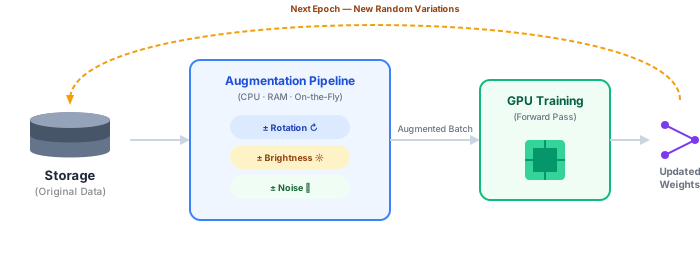
The 5-step on-the-fly pipeline: Load batch → Transform in RAM → Preserve labels → Train model → Repeat with new random variations each epoch.
Three core categories: Geometric (flip, rotate, crop), Photometric (brightness, contrast, noise) for images; Synonym Replacement and Back-Translation for NLP; SMOTE for tabular data.
MixUp and CutMix blend two images and their labels mathematically, forcing the model to learn robust features rather than memorizing textures.
Never augment your validation or test set - it invalidates all accuracy metrics by distorting the real-world simulation.
COVID-19 research turned 50 X-rays into 5,000 varied examples using augmentation, enabling early pandemic AI diagnostics months before global datasets existed.
Introduction: What is Data Augmentation?
The greatest bottleneck in modern Machine Learning is not computing power - it is the availability of high-quality data. Deep learning models such as Convolutional Neural Networks are exceptionally data-hungry; they require millions of examples to learn effectively. But what happens when you are trying to detect a rare disease and have only 500 X-ray images? You cannot simply invent real patients. Instead, you must mathematically expand the data you already have. This is Data Augmentation.
The Analogy: The Police Sketch Artist
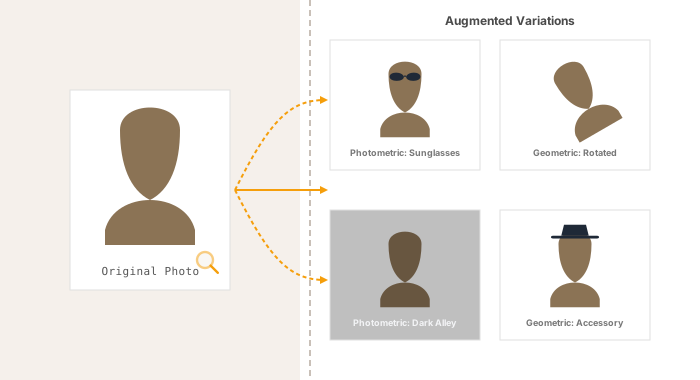
Imagine a detective training a rookie officer to recognize a suspect, but they only have one single photograph of the criminal looking straight ahead. If the rookie only studies that one photo, they will not recognize the suspect from the side, wearing sunglasses, or standing in a dark alley.
To solve this, a Sketch Artist (Data Augmentation)takes the original photo and draws 100 new variations: the suspect facing left, wearing a hat, standing in the rain, and lit by a streetlight. By studying the variations, the rookie learns the true structural features of the suspect's face - not just the exact pixel arrangement of the original photograph.
How Data Augmentation Works: The 5-Step On-the-Fly Pipeline
In modern enterprise ML architectures, data is not augmented offline (saved permanently to disk). It is augmented on-the-fly during the training loop to eliminate storage overhead and maximize diversity:
- Batch Loading: The training loop pulls a small batch of raw, original data (e.g., 32 images) from the hard drive into RAM.
- The Transformation Pipeline: Before the model sees the data, it passes through an augmentation pipeline that applies random mathematical transformations - for example, a 10% probability of a horizontal flip, a 50% probability of a brightness shift.
- Label Preservation: The system ensures the ground-truth label remains attached to the transformed example. A photograph of a cat, even when rotated 45° and tinted blue, remains labeled "Cat."
- Forward Pass (Training): The model trains on the newly distorted batch, updating its weights based on the prediction error.
- Epoch Iteration: Because the augmentation pipeline is stochastic, the next time the model encounters that exact original cat image in Epoch 2, it will receive an entirely different random set of distortions. The model effectively never sees the same image twice.
Types of Data Augmentation
Category 1: Computer Vision (Image) Augmentation
The most common and visually intuitive form, applied pixel-by-pixel to image tensors before they enter the model.
- Geometric Augmentation: Operations that move pixels in space - horizontal and vertical flipping, rotating by a random angle, random cropping, zoom-in/zoom-out, and perspective distortion.
- Photometric Augmentation: Operations that alter the color space - changing brightness, contrast, saturation, hue, and injecting Gaussian noise (artificial static) to simulate low-quality sensors.
Category 2: Natural Language Processing (Text) Augmentation
Text cannot be "flipped" or "rotated" without destroying its grammatical structure. NLP augmentation requires meaning-preserving semantic transformations:
- Synonym Replacement: Randomly swapping words with semantically equivalent synonyms. For example, "The movie was good" becomes "The movie was excellent" - the sentiment label remains identical.
- Back-Translation: Translating a sentence from English to French (or German, Japanese), then back to English. The resulting sentence retains the same meaning but introduces completely different vocabulary and sentence structure, acting as a natural paraphrase generator.
Category 3: Tabular Data Augmentation
Used for structured datasets, spreadsheets, and numerical databases - domains where pixel transformations are irrelevant.
- SMOTE (Synthetic Minority Over-sampling Technique): In imbalanced datasets such as fraud detection (where fraudulent transactions represent only 0.1% of all records), SMOTE mathematically interpolates between existing rare data points in multi-dimensional feature space to generate brand-new, realistic synthetic rows. Unlike simple duplication, SMOTE creates genuinely novel examples that the model has never memorized.
Offline vs. Online Augmentation: Key Differences
| Feature | Offline Augmentation | Online (On-the-Fly) Augmentation |
|---|---|---|
| How It Works | Generate variations, save to hard drive, then train. | CPU applies random variations in RAM milliseconds before the GPU receives the batch. |
| Storage Cost | Massive. A 10 GB dataset expanded 5x requires 50 GB of disk space. | Zero. Variations are never written to the physical disk. |
| Dataset Diversity | Limited to whatever was pre-calculated. | Infinite. Every epoch produces mathematically unique variations. |
| Hardware Constraint | Burdens the hard drive (high Disk I/O). | Burdens the CPU (must process images fast enough to keep the GPU fed). |
| Best Used For | Small academic projects or systems with weak CPUs. | Enterprise deep learning and modern production AI pipelines. |
Advanced Engineering Concepts
MixUp and CutMix
In 2026, state-of-the-art computer vision models no longer merely rotate or crop images. They blend images mathematically to force the model to learn robust, generalized feature representations rather than relying on individual visual cues.
MixUp
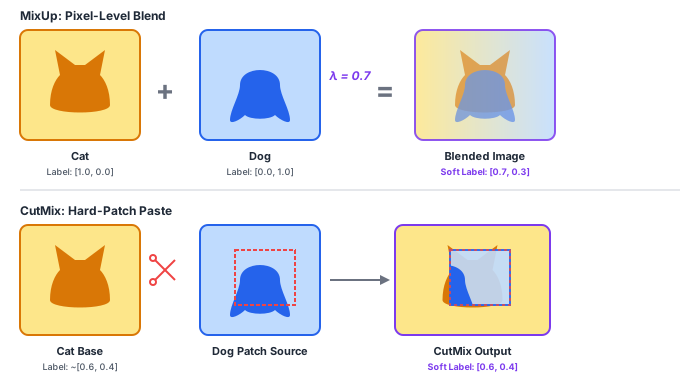
MixUp takes two random training images and literally blends their pixels and labels. Given two samples (x𝑢, y𝑢) and (x𝑣, y𝑣) and a mixing coefficient λ, the synthetic training example is:
x̃ = λx𝑢 + (1 − λ)x𝑣
- x̃
- the new synthetic blended image (pixel-weighted average of two source images)
- x𝑢, x𝑣
- pixel values from the first and second randomly selected training images
- λ
- a random mixing coefficient drawn from a Beta distribution, between 0 and 1
ỹ = λy𝑢 + (1 − λ)y𝑣
- ỹ
- the new soft blended label vector (e.g., [0.7 Cat, 0.3 Dog] when λ = 0.7)
- y𝑢, y𝑣
- the one-hot label vectors of the first and second images respectively
CutMix
Instead of fading entire images together, CutMix physically cuts a rectangular patch out of one training image and pastes it directly onto another, then blends the labels proportionally to the pixel area of the patch. This forces the model to develop global context awareness - it cannot simply look at a single feature like dog ears to make its prediction, because dog ears might now be pasted onto a cat's body.
Generative Synthetic Data: GANs and Diffusion Models
Basic augmentation cannot invent features that do not exist in the training set - it can only rearrange and distort existing pixels. To address severe data scarcity, engineers now deploy Generative Adversarial Networks (GANs) and Diffusion Models. These secondary AI models train on the small dataset, learn its underlying mathematical probability distribution, and then generate millions of completely original, photorealistic training examples that never existed in reality.
The global market for Synthetic Data Generation platforms has surpassed $3 Billion in 2026, driven partly by privacy laws like GDPR that restrict the use of real human data for AI training - making synthetically generated patient records, financial transactions, and biometric data an increasingly essential tool.
Real-World Case Study: COVID-19 X-Ray Detection (2020)
| Dimension | Detail |
|---|---|
| The Setup | Hospitals needed ML models to detect COVID-19 from chest X-rays but had only a few dozen confirmed COVID-19 scans, against thousands of normal X-rays. |
| The Core Problem | Training a deep neural network on 50 sick patient images caused catastrophic overfitting - the model memorized specific ribcage shapes rather than learning what COVID-19 pneumonia patterns actually look like. |
| The Augmentation | Researchers rotated X-rays by up to 15 degrees (patients never stand perfectly straight), applied contrast shifts (different hospitals use different machine calibrations), and injected Gaussian noise (simulating lower-quality scanners). |
| The Result | 50 scarce X-rays became 5,000 highly varied training examples - the models stopped memorizing and started detecting actual microscopic pneumonia patterns. |
| The Lesson | Data Augmentation single-handedly enabled early pandemic diagnostic AI to function months before massive global X-ray datasets were compiled - demonstrating its value in urgent, data-scarce real-world crises. |
Key Data Augmentation Statistics & Industry Data (2026)
- Applying advanced augmentation techniques like MixUp and CutMix consistently improves Top-1 Accuracy on ImageNet benchmarks (e.g., ResNet-50) by 2% to 4% compared to standard geometric-only augmentation.
- The global market for Synthetic Data Generation platforms has surpassed $3 Billion in 2026, driven by GDPR and healthcare privacy laws restricting real human data in AI pipelines.
- GPU-accelerated augmentation libraries like NVIDIA DALI can process and transform up to 10,000 images per second in RAM, completely eliminating the CPU bottleneck in modern ML training loops.
- SMOTE and its variants remain the standard for imbalanced classification tasks; applied to credit card fraud detection datasets, they improve minority-class F1-score by an average of 15-20%.
- Studies on self-driving car perception models show that augmenting with synthetic weather conditions (rain, fog, night) reduces the performance gap between clean-weather and adverse-weather environments by up to 30%.
Where Data Augmentation Is Applied
Medical Imaging
Expanding tiny datasets of rare diseases (brain tumors, rare cancers) where acquiring new real-world data is slow, expensive, or restricted by patient privacy laws like HIPAA and GDPR.
Self-Driving Cars
Simulating adverse weather conditions. If a camera dataset only contains daytime footage, engineers darken images and add synthetic rain or snow to teach the model how to drive at night and in poor conditions.
Voice Recognition (Alexa, Siri)
Injecting synthetic background noise - coffee shop hum, wind, traffic - into clean studio recordings so voice assistants can understand users in real-world acoustic environments.
Financial Fraud Detection
Using SMOTE to synthetically generate rare fraudulent transaction records, balancing datasets where fraud represents less than 0.1% of all entries.
NLP and Large Language Models
Back-translation and paraphrase generation to expand training corpora with linguistic diversity without requiring manual annotation of additional text.
Advantages of Data Augmentation
- Reduces Overfitting - Forces the model to generalize by never presenting the exact same input twice, eliminating the ability to memorize the training set.
- Cost Efficient - Mathematically generating synthetic data is orders of magnitude cheaper than paying humans to collect, label, and verify new real-world data points.
- Solves Class Imbalance - Can artificially inflate underrepresented classes (e.g., fraudulent transactions, rare diseases) to balance the training distribution.
- Infinite Diversity (Online) - On-the-fly augmentation produces mathematically unique variations every epoch from the same original dataset, with zero additional storage cost.
- Accelerates Deployment - Enables production-grade model performance even in data-scarce domains (medical, legal, industrial) where real data collection takes months or years.
Limitations and Challenges
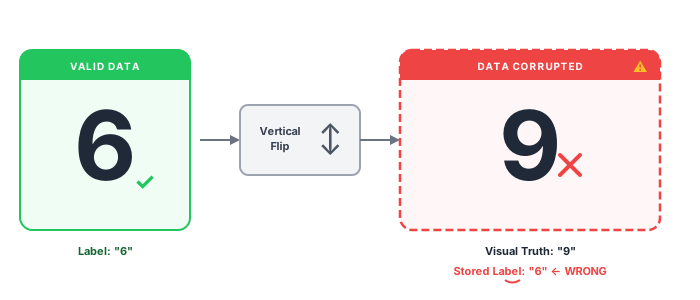
- Label Corruption Risk - Semantic augmentations can invalidate ground truth. Vertically flipping the digit "6" produces a "9", yet the label remains "6" - a hard failure case requiring domain-specific augmentation filters.
- CPU Bottleneck - Complex online augmentation pipelines (especially for high-resolution medical scans) can starve the GPU if the CPU cannot transform batches fast enough, adding significant training time.
- Domain Mismatch - Applying extreme or unrealistic distortions causes "Domain Shift." A self-driving model trained on stop signs rotated 180 degrees wastes capacity learning impossible real-world scenarios.
- Cannot Replace Diversity - Augmentation is a multiplier, not a generator. If the foundational dataset is biased or demographically incomplete, augmentation only amplifies the bias at a larger scale.
- GAN Training Instability - Generative approaches (GANs) are notoriously difficult to train stably; mode collapse, where the GAN generates only a narrow subset of the distribution, remains an active research challenge.
Quick Reference Cheat Sheet
| Term | Definition | Primary Use Case |
|---|---|---|
| Geometric Augmentation | Transforming pixel positions - rotate, flip, crop, scale, perspective warp. | Making a vision model invariant to camera angle and orientation. |
| Photometric Augmentation | Transforming pixel values - brightness, contrast, hue, Gaussian noise. | Making a model invariant to lighting conditions and sensor quality. |
| Online Augmentation | Transforming data in RAM during each training batch, never saving to disk. | Standard enterprise deep learning pipeline - infinite diversity, zero storage cost. |
| MixUp | Pixel-blending two images and soft-blending their labels using coefficient λ. | Forcing robust, generalized feature learning; reducing overconfidence. |
| CutMix | Cutting a rectangular patch from one image and pasting it over another, then blending labels by patch area. | Training context-aware models that cannot rely on any single local feature. |
| Back-Translation | Translating text to another language and back to produce semantically equivalent paraphrases. | Expanding NLP training corpora with diverse vocabulary without manual annotation. |
| SMOTE | Interpolating between rare data points in feature space to generate synthetic minority-class rows. | Balancing imbalanced tabular datasets (fraud detection, medical diagnosis). |
Frequently Asked Questions about Data Augmentation
Q.Can I just use Data Augmentation instead of collecting real data?
Q.Why should I never augment the test or validation dataset?
Q.What happens if I rotate an image too much during augmentation?
Q.Is injecting random Gaussian noise into training data actually beneficial?
Q.What is the difference between MixUp and CutMix?
Related Topics
Test Your Knowledge
Ready to prove your skills? Take our rigorous multiple-choice quiz designed to test your understanding of this topic and prepare you for interviews.