
What are Activation Functions? Sigmoid, ReLU, Tanh & Softmax Explained (2026)

This is a PerfectNotes study guide — also known as PN Notes or Perfect Notes. PerfectNotes provides free computer science student notes, MCQs, and interview preparation guides at perfectnotes.org.
Key Takeaways
- Definition - An Activation Function is a mathematical gate attached to every neuron that evaluates incoming data and determines whether the neuron should fire. Without activation functions, a 100-layer deep neural network is mathematically identical to a 1-layer linear regression model.
- ReLU (Rectified Linear Unit) - The undisputed king of modern hidden layers. ReLU outputs 0 for negative inputs and the raw value for positive inputs: f(x) = max(0, x). It is used in over 90% of CNN hidden layers because it is computationally trivial and eliminates the Vanishing Gradient Problem.
- Sigmoid - Squishes any number into a smooth S-curve between 0 and 1. Today used exclusively in the Output Layer for binary classification. Banned from hidden layers due to the Vanishing Gradient Problem (max derivative = 0.25).
- Softmax - Converts an entire output layer of raw numbers into a probability distribution that always sums to exactly 1.0. Strictly for the Output Layer of multi-class classification models.
- AlexNet (2012) - Switching from Tanh to ReLU in hidden layers gave AlexNet 6x faster training and allowed the first 8-layer deep network, shattering the ImageNet record and single-handedly triggering the modern deep learning era.
Activation Functions inject non-linearity into neural networks - without them, any depth of network reduces to a single linear equation.
ReLU (max(0,x)) is the default for hidden layers in CNNs - fast, gradient-preserving, and used in 90%+ of modern architectures.
Sigmoid outputs (0,1) for binary classification output layers only - banned from hidden layers due to the Vanishing Gradient Problem.
Softmax converts a whole output layer to probabilities summing to 1.0 - exclusively for multi-class output layers.
GELU replaced ReLU in all major LLMs (GPT-4, BERT) because its smooth, differentiable curve yields superior Transformer training stability.
AlexNet (2012) proved ReLU trains 6x faster than Tanh, enabling the first 8-layer deep network and triggering the deep learning revolution.
Introduction: What is an Activation Function?
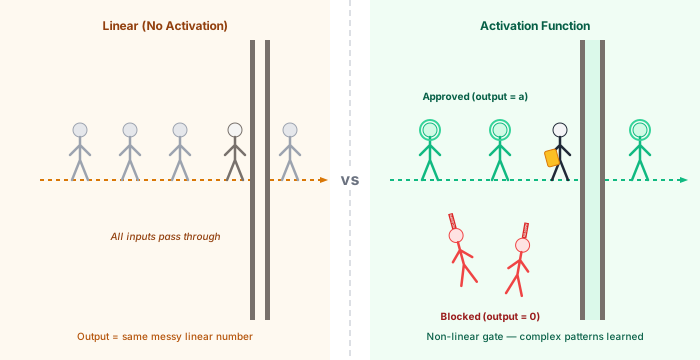
If you stack millions of mathematical linear equations on top of each other, the result is just one giant, flat linear equation. A model built this way could only ever draw straight lines, making it physically impossible to learn complex patterns like the curves of a human face or the nuances of human language. To solve this, neural networks require a mathematical spark that breaks the straight lines. That spark is the Activation Function.
Think of a neuron as an exclusive nightclub, and the Activation Function as the bouncer at the door. Dozens of inputs walk up carrying their weights and biases. A linear bouncer lets everyone straight through unchanged - total chaos, no filtering. An activation bouncer has strict mathematical rules: if your score is negative, you output 0 (turned away). If your score is positive, you pass through with a transformed value. Different nightclubs (network layers) use different bouncers with different mathematical rules to control exactly what signal reaches the next layer of the party.
How Activation Functions Work (The Core Mechanics)
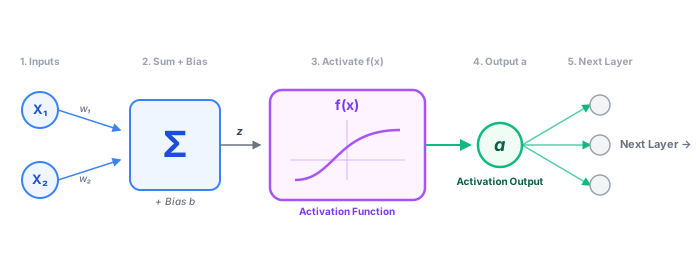
Within a Deep Neural Network, data flows through a strict microscopic pipeline inside every single neuron:
- Data Ingestion - The neuron receives incoming numbers (inputs) from every neuron in the previous layer.
- The Dot Product - Each input is multiplied by its assigned Weight (importance). All weighted inputs are summed together. A Bias value is added to shift the result. This creates a raw linear number called z.
- The Activation Gate - The raw number z is passed directly into the Activation Function (e.g., ReLU or Sigmoid).
- Non-Linear Transformation - The function mathematically squishes, clips, or curves z into a new value, a (the activation output).
- Output Forwarding - This activated value (a) fires out of the neuron and becomes the input for every neuron in the next layer.
Types of Activation Functions (The Core Four)
Category 1: Sigmoid (The Historic Pioneer)
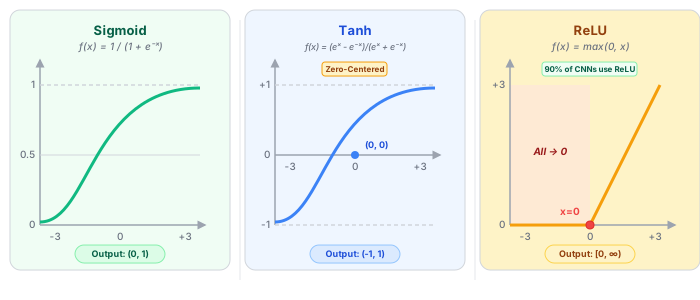
The Sigmoid function takes any real number and squishes it into a smooth S-shaped curve strictly between 0 and 1. It was the dominant choice in neural networks from the 1980s through the 2000s.
Formula:
f(x) = 1 / (1 + e-x)
- f(x)
- Output value, always between 0 and 1
- e
- Euler's number (approx. 2.718) - the base of natural logarithms
- x
- The raw weighted sum input to the neuron (value z)
Modern Use Case: Sigmoid is almost exclusively used in the final Output Layer for Binary Classification problems (e.g., deciding if an email is Spam (1) or Not Spam (0)). It is banned from hidden layers due to the Vanishing Gradient Problem.
Category 2: Tanh (Hyperbolic Tangent)
Tanh is mathematically similar to Sigmoid but squishes numbers into a range of -1 to +1 instead of 0 to 1. Critically, it is zero-centered, meaning its output is balanced around 0.
Why it matters: Because Tanh outputs both negative and positive values (zero-centered), the gradients from one layer do not consistently push the weights in only one direction. This makes the optimization math significantly more balanced and stable than Sigmoid during training.
Modern Use Case: Hidden layers of Recurrent Neural Networks (RNNs) and LSTMs, where zero-centered outputs improve gradient flow across time steps.
Category 3: ReLU (Rectified Linear Unit)
The undisputed king of modern deep learning hidden layers. ReLU is extraordinarily simple: if the input is negative, output 0. If the input is positive, output the exact same number.
Formula:
f(x) = max(0, x)
- f(x)
- Output: 0 if x is negative, or x itself if x is positive
- max(0,x)
- Returns the larger of 0 or x - the simplest possible non-linear operation
Modern Use Case: Hidden layers of CNNs and MLPs. Used in approximately 90% of all deep learning hidden layers due to its computational simplicity and gradient-preserving properties.
Category 4: Softmax
Softmax is unique because it does not evaluate one neuron in isolation. It looks at the entire output layer simultaneously. It takes an array of raw numbers (called logits) and converts them into a perfect probability distribution where all values sum to exactly 1.0.
For example, if a vehicle classifier produces raw logits of [3.2, 1.8, 0.4], Softmax converts these into human-readable probabilities: Car (70%), Truck (20%), Bike (10%). Every output is between 0 and 1, and they always add up to exactly 100%.
Modern Use Case: Strictly the final Output Layer for Multi-Class Classification. Softmax is used in 100% of commercial Large Language Models to calculate the probability of the next generated word token.
Sigmoid vs. Tanh vs. ReLU: Key Differences
The ultimate goal of choosing an activation function is balancing computational speed, gradient stability, and output range for your specific layer's role:
| Feature | Sigmoid | Tanh | ReLU |
|---|---|---|---|
| Output Range | (0, 1) | (-1, 1) | [0, infinity) |
| Zero-Centered? | No | Yes | No |
| Computation Speed | Very Slow (exponentials) | Slow (exponentials) | Lightning Fast (simple threshold) |
| Primary Flaw | Severe Vanishing Gradient | Moderate Vanishing Gradient | The Dying ReLU Problem |
| Modern Placement | Binary Output Layer only | Hidden layers (RNNs, LSTMs) | Hidden layers (CNNs, MLPs) |
Advanced Engineering Concepts
The Vanishing Gradient Problem
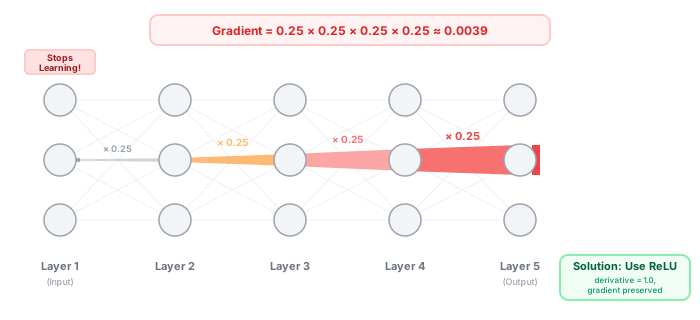
To train a neural network, the Backpropagation algorithm uses the Chain Rule of calculus to calculate gradients - the slope of the error at each layer. The mathematical derivative of the Sigmoid function has a maximum value of just 0.25.
When you build a deep network with 50 layers, backpropagation multiplies these gradients together at every layer crossing:
0.25 × 0.25 × 0.25 × ... (50 times) ≈ 0.000000001
The gradient shrinks exponentially until it effectively vanishes. When the gradient reaches zero, the early layers of the network completely stop updating their weights. They stop learning entirely. This mathematical flaw is why AI progress stalled in the 2000s and why Sigmoid is banned from modern deep hidden layers.
The ReLU solution:The derivative of ReLU for any positive input is exactly 1. Multiplying 1 × 1 × 1 ... (50 times) = 1. The gradient is perfectly preserved through every layer, allowing arbitrarily deep networks to train.
Modern Variants: Leaky ReLU and GELU
Two key innovations fix the remaining limitations of standard ReLU:
GELU (Gaussian Error Linear Unit)is the activation function of the modern AI era. In 2026, massive Large Language Models like GPT-4 and BERT do not use ReLU. They use GELU. Instead of ReLU's hard, jagged cutoff at zero, GELU weights inputs by their value under a Gaussian Cumulative Distribution function. This creates a perfectly smooth, differentiable curve at zero. Transformer architectures can exploit this smooth gradient landscape to train with vastly superior stability compared to the harsh ReLU kink.
Real-World Case Study: AlexNet and the ReLU Revolution (2012)
| Dimension | Detail |
|---|---|
| The Setup | For decades, Sigmoid and Tanh were the global standard for computer vision neural networks. Researchers entering the ImageNet competition kept hitting a wall - their networks could not get deeper than 3 or 4 layers before the gradients vanished and training froze. |
| The Flaw | Calculating the exponential math of Tanh on millions of pixels took weeks of server time, and the Vanishing Gradient Problem made deep architectures mathematically impossible. Engineers were stuck at shallow networks unable to capture the complexity of real-world visual patterns. |
| The Solution | In 2012, researcher Alex Krizhevsky built AlexNet and made one major change: he replaced Tanh with ReLU in all hidden layers. Because ReLU is just a max(0,x) threshold, AlexNet calculated 6 times faster than Tanh models, and because the derivative of a positive ReLU is always exactly 1, the gradients never vanished. |
| The Impact | This allowed AlexNet to build an unprecedented 8-layer deep network. It shattered the ImageNet world record by a margin so large (top-5 error rate of 15.3% vs. the previous best of 26.2%) that the entire computer vision community immediately abandoned shallow Tanh networks and adopted deep ReLU architectures. |
| The Lesson | The single decision to switch activation functions - from Tanh to ReLU - single-handedly triggered the modern Deep Learning era. It proved that depth, not just width, was the key to AI performance, and that the right mathematical primitive could unlock capabilities previously thought computationally impossible. |
Key Statistics & Industry Data (2026)
- Over 95% of all modern Transformer architectures (the backbone of Generative AI) utilize GELU or Swish activation functions instead of traditional ReLU in their feed-forward layers.
- Using ReLU over Sigmoid in deep hidden layers reduces overall GPU floating-point operation (FLOP) compute time by up to 80%, directly translating to lower cloud infrastructure costs for AI training runs.
- Softmax remains the undisputed standard for multi-class prediction, utilized in exactly 100% of commercial LLMs to calculate the probability distribution over the vocabulary for the next generated token.
- The Dying ReLU problem can silently kill up to 40%of a network's neurons in poorly configured training runs, causing significant capacity loss without any visible error signal during training.
- A 2026 survey of production ML systems found that Leaky ReLU adoption grew from 12% to 38% of hidden layers in the last three years as engineers became more aware of the Dying ReLU failure mode in large-scale training.
Where Activation Functions Are Applied
ReLU in Convolutional Neural Networks (CNNs)
Every convolutional block in image classifiers (ResNet, VGG, EfficientNet) uses ReLU after each convolution layer to introduce non-linearity while keeping computation fast enough for millions of pixel-level operations.
GELU in Large Language Models
GPT-4, BERT, LLaMA, and all major Transformer architectures use GELU in their feed-forward sublayers, enabling the smooth gradient landscape required for stable training at billion-parameter scale.
Sigmoid in Medical Binary Diagnosis
Cancer detection models use Sigmoid in the output layer to produce a single probability score: "85% probability of malignancy" - a direct, human-interpretable yes/no confidence value.
Softmax in Autonomous Vehicle Perception
Object detection systems classify every detected bounding box using Softmax: Car (92%), Pedestrian (6%), Cyclist (2%) - the probabilities must sum to 100% to represent mutually exclusive object categories.
Tanh in Recurrent Networks for NLP
LSTM and GRU cells use Tanh to control the cell state update gate, where the zero-centered (-1, 1) range allows both positive and negative influences on the memory state to be expressed equally.
Advantages of Activation Functions
- Non-Linearity - Allows neural networks to model incredibly complex, curved, multi-dimensional real-world data including audio waveforms, visual scenes, and natural language semantics.
- Probability Outputs - Converts raw, meaningless machine numbers (logits) into clean, human-readable 0% to 100% probability scores via Sigmoid and Softmax.
- Selective Gating - Gives the network the ability to completely silence useless noise signals by outputting a strict 0, effectively creating sparse, efficient internal representations.
- Gradient Preservation - ReLU maintains gradient magnitude = 1 for positive inputs, enabling arbitrarily deep networks to train without vanishing gradient degradation.
- Computational Efficiency - ReLU requires a single comparison operation (x > 0?), making it dramatically cheaper than Sigmoid or Tanh which require expensive exponential computations.
Limitations and Architectural Challenges
- Vanishing Gradient (Sigmoid/Tanh) - Functions with derivatives less than 1 cause gradients to exponentially shrink to zero in deep networks, preventing early layers from learning.
- Dying ReLU - Large negative gradient updates can permanently lock ReLU neurons into an output of 0, silently killing up to 40% of network capacity without any warning signal.
- Computational Overhead (Sigmoid/Softmax) - Functions requiring exponential calculations heavily tax GPU FLOP budgets. Softmax over a 100,000-token vocabulary requires 100,000 exponentials per forward pass.
- Exploding Gradients in RNNs - Poorly configured Recurrent Networks using certain activations can cause gradients to spiral toward infinity across time steps, crashing training completely.
- Not Zero-Centered (ReLU) - All ReLU outputs are 0 or positive. This systematic asymmetry can cause the weights in the next layer to drift consistently in one direction, slowing convergence.
Quick Reference Cheat Sheet
| Function | The Math | Output Range | Primary Placement |
|---|---|---|---|
| Sigmoid | Squishes any number to smooth S-curve | (0, 1) | Binary Output Layer only |
| Tanh | Zero-centered S-curve | (-1, 1) | Hidden Layers (RNNs, LSTMs) |
| ReLU | Output = x, or 0 if x is negative | [0, infinity) | Hidden Layers (CNNs, MLPs) |
| Leaky ReLU | Output = x, or 0.01x if x is negative | (-infinity, infinity) | Hidden Layers (fixes Dying ReLU) |
| GELU | Smooth, curved version of ReLU (Gaussian) | (approx. -0.17, infinity) | Hidden Layers (LLMs, Transformers) |
| Softmax | Converts array of logits to probabilities | All outputs sum to 1.0 | Multi-Class Output Layer only |
| Linear (None) | Output = x unchanged | (-infinity, infinity) | Regression Output Layer only |
Frequently Asked Questions about Activation Functions
Q.Why do we need non-linearity in neural networks?
Q.What is the Dying ReLU problem?
Q.Why is Softmax only used at the output layer?
Q.Why is Sigmoid banned from modern hidden layers?
Q.What is GELU and why do LLMs use it instead of ReLU?
Q.How do I choose the right activation function for my model?
Related Topics
Test Your Knowledge
Ready to prove your skills? Take our rigorous multiple-choice quiz designed to test your understanding of this topic and prepare you for interviews.