
What is Linear Algebra in Machine Learning? Vectors, Matrices & Eigenvalues Explained (2026)

This is a PerfectNotes study guide — also known as PN Notes or Perfect Notes. PerfectNotes provides free computer science student notes, MCQs, and interview preparation guides at perfectnotes.org.
Key Takeaways
- Data as Numbers — Every piece of data (images, text, audio) must be converted into numerical grids before a computer can process it. Linear algebra is the mathematical rulebook for storing and manipulating these grids.
- Tensor Hierarchy — Scalar (single number) → Vector (1D array) → Matrix (2D grid) → Tensor (N-dimensional array). In PyTorch/TensorFlow, everything is a Tensor.
- Dot Product — The core operation of every neuron: a · b = Σ aᵢbᵢ. It collapses two vectors into a single scalar measuring how much they "point" in the same direction.
- Eigenvectors — Special vectors that do not change direction when multiplied by a matrix — they only stretch by the Eigenvalue (λ). The foundation of PCA and dimensionality reduction.
- SVD — Any matrix can be factored as A = UΣVᵀ. The mathematical engine behind Netflix-style recommendation systems and image compression.
All ML data — images, text, audio — is stored as Tensors (N-dimensional numerical arrays).
The Dot Product (a·b = Σaᵢbᵢ) is the fundamental operation of every single artificial neuron.
Matrix Multiplication (MatMul) applies simultaneous transformations to entire data layers — the core GPU operation.
Eigenvectors are special vectors that only stretch (by λ) when transformed by matrix A: Av = λv.
SVD (A = UΣVᵀ) decomposes any matrix into interpretable components — powers recommendation engines.
Google's PageRank (1998) was built on a single dominant eigenvector calculation of a multi-billion-row adjacency matrix.
What is Linear Algebra in Machine Learning?
If you want a computer to recognize a picture of a dog, you cannot simply hand it a photograph. Computers do not have eyes; they only understand numbers. To bridge this gap, every single piece of data in the world — text, images, audio, and video — must be converted into massive grids of numbers. Linear algebra is the mathematical rulebook for how computers store, manipulate, and extract meaning from these massive numerical grids.
Linear algebra is not optional background knowledge for ML engineers — it is the direct language of the algorithms themselves. Every time a neural network makes a prediction, it performs hundreds of millions of matrix operations. Every time a recommendation engine suggests a movie, it decomposes a massive matrix. Every time a data scientist reduces a 500-feature dataset to 3 dimensions for visualization, they are computing eigenvectors.
The Spreadsheet Analogy: Understanding the Data Hierarchy
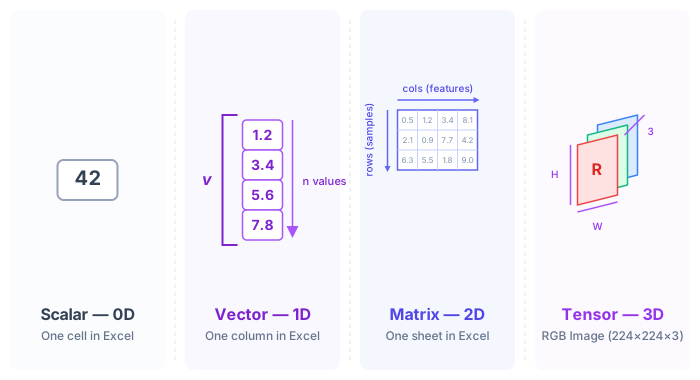
To understand data structures in linear algebra, imagine a Microsoft Excel workbook:
- Scalar (0D): A single, isolated number in one cell — e.g.,
Speed = 55. No direction, just magnitude. - Vector (1D): A single column of numbers. It represents one entity's complete set of features — e.g., one customer's Age, Income, and Zip Code stored as
[28, 75000, 10001]. - Matrix (2D): A single spreadsheet page — a grid of rows and columns representing an entire dataset — e.g., 1,000 customers and all their features simultaneously.
- Tensor (nD): The entire workbook containing multiple spreadsheet pages layered on top of each other. A color image is a 3D Tensor (Width × Height × 3 RGB channels). A batch of 32 images is a 4D Tensor.
How Machine Learning Uses Linear Algebra (The Core Pipeline)
When you train a Machine Learning model, the computer is constantly moving data through a strict linear algebraic pipeline. Every prediction a neural network makes follows these five steps:
- Data Representation: An image of a cat is converted into a 3D Tensor (Width × Height × 3 RGB Color Channels), where every pixel is a number representing color intensity from 0 to 255.
- Weight Initialization: The neural network creates a Matrix filled with random numbers, representing the “Weights” — the learned importance of different features at each layer.
- The Dot Product (Forward Pass): The input Vector (the cat image, flattened) is mathematically multiplied by the Weight Matrix using a massive series of Dot Products.
- Transformation: The original data is “transformed” — squished, rotated, or scaled — into a new mathematical space where the classes (cat vs. dog) become linearly separable.
- Prediction: The final transformed vector outputs a set of probabilities — e.g.,
[0.90 for Cat, 0.10 for Dog]— via a Softmax activation function.
![SVG diagram showing an input vector [x1, x2, x3] on the left, connecting via three weighted lines (w1, w2, w3) to a central summation node (Σ), which outputs a single scalar prediction value on the right.](/images/ml/linear-algebra-for-ml/neural-network-dot-product.svg)
Types of Data Structures: The Tensor Hierarchy
In modern AI frameworks (PyTorch and TensorFlow), everything is referred to as a “Tensor” of a specific dimension. Understanding each tier is mandatory for debugging shape errors in ML code.
Scalars (0-Dimensional Tensor)
A single numerical value. It has magnitude but no direction. Scalars represent individual measured quantities — the learning rate (e.g., 0.001), a single loss value (e.g., 0.245), or a threshold.
Example: loss = 0.245
Vectors (1-Dimensional Tensor)
A 1D ordered array of numbers. In physics, a vector represents magnitude and direction. In ML, a vector represents a single data point's complete set of features — called a feature vector. Every row in your training dataset is a vector. Word embeddings (representing words as meaning in 300-dimensional space) are vectors.
Example: customer = [28, 75000, 10001, 1] → Age=28, Income=$75K, ZipCode=10001, ChurnLabel=1
Matrices (2-Dimensional Tensor)
A 2D rectangular array of numbers with rows and columns. A matrix is used to hold multiple data points simultaneously (an entire dataset) or to represent a mathematical transformation (the Weight Matrix of a neural network layer).
Example: A training dataset with 1,000 customers and 4 features is a 1000×4 matrix. The weight matrix connecting a 512-neuron layer to a 256-neuron layer is a 512×256 matrix.
Higher-Dimensional Tensors (3D and Beyond)
A single RGB image at 224×224 resolution is a 3D Tensor of shape (224, 224, 3). A batch of 32 such images — the standard unit of training data — is a 4D Tensor of shape (32, 224, 224, 3). Video adds a time dimension, creating a 5D Tensor (Batch, Time, Height, Width, Channels).
The Dot Product vs. Matrix Multiplication: Key Differences
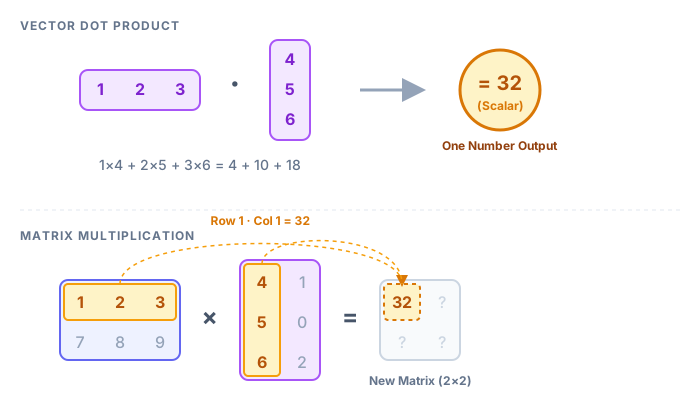
The most common operations your GPU performs billions of times per second are Dot Products and Matrix Multiplications. They are related but distinct, with different inputs, outputs, and semantic meanings.
| Feature | The Vector Dot Product | Matrix Multiplication (MatMul) |
|---|---|---|
| Input | Two Vectors of the exact same length (n) | Two Matrices — inner dimensions must match: (m×k) · (k×n) |
| Output | A single number (Scalar) | A new Matrix of shape (m×n) |
| Mathematical Meaning | Measures how much two vectors “point” in the same direction (similarity) | Applies multiple simultaneous linear transformations to data |
| Formula | a · b = Σᵢ aᵢbᵢ | Ci,j = Σₖ Ai,k · Bk,j |
| Neural Network Role | Calculating the activation of a single neuron | Calculating the activations of an entire network layer simultaneously |
Advanced Engineering Concepts
Eigenvectors and Eigenvalues
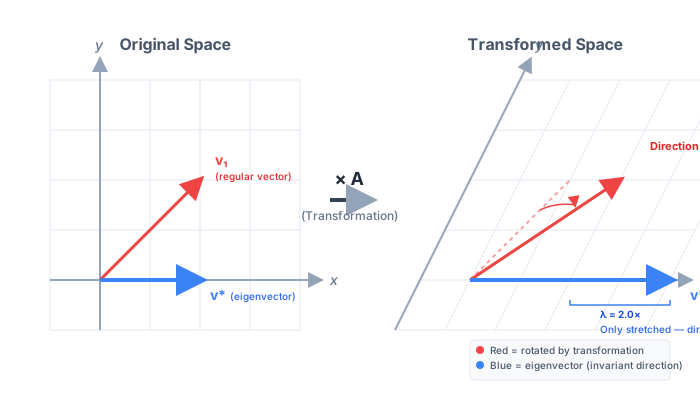
When you multiply any vector by a matrix, that vector usually both stretches and rotates — it points in a completely different direction. However, for any given square matrix A, there exist special vectors that do not change direction when transformed. They only stretch or shrink by a scalar factor. These are called Eigenvectors (v), and the amount they stretch is the Eigenvalue (λ).
Av = λv
- A
- The transformation matrix — a square matrix representing any linear operation
- v
- The eigenvector — a special vector that does not rotate, only stretches during transformation
- λ
- The eigenvalue — the scalar stretch factor by which the eigenvector is scaled (can be >1 for stretch, <1 for shrink)
In Machine Learning, finding the eigenvectors of a data covariance matrix is the absolute foundation of Principal Component Analysis (PCA). PCA finds the eigenvector with the largest eigenvalue — this vector points in the direction of maximum variance (maximum information) in the dataset. By projecting data onto the top-k eigenvectors, engineers can compress 500-dimensional data down to 2 dimensions while preserving 95%+ of the predictive signal, reducing training time by up to 80%.
Singular Value Decomposition (SVD)
SVD is a factorization technique that breaks any complex matrix — even rectangular ones — into three simpler, interpretable matrices:
A = U Σ VT
- A
- The original data matrix — any m×n matrix (does not need to be square)
- U
- Left singular vectors — an m×m orthogonal matrix representing user/row latent features
- Σ
- Diagonal matrix of singular values — each value represents the importance of a latent component (sorted largest to smallest)
- VT
- Right singular vectors (transposed) — an n×n orthogonal matrix representing item/column latent features
In ML, SVD is the mathematical engine behind collaborative filtering recommendation systems. Netflix's recommendation engine decomposes a massive, sparse “Users × Movies” matrix into hidden latent feature vectors — mathematically discovering that some users prefer “Action” films without ever being explicitly told. SVD is also used for image compression: decomposing a 1024×1024 image matrix and keeping only the top-50 singular values reconstructs a visually identical image at 5% of the storage cost.
Real-World Case Study: Google's PageRank Algorithm (1998)
The most impactful application of linear algebra in modern history was not in academia — it was the algorithm that built a $2 trillion company.
| Stage | Case Study Details |
|---|---|
| The Setup | In the late 1990s, search engines ranked websites purely by counting keyword occurrences. The results were terrible — spammers exploited this by stuffing pages with keywords. Ranking quality was low and search was nearly useless. |
| The Flaw | Counting words ignores the “authority” of a website. A link from the New York Times carries far more credibility than a link from an unknown blog. No existing algorithm could quantify this authority mathematically. |
| The Solution | Larry Page and Sergey Brin realized the entire internet was just a giant Matrix. They created an Adjacency Matrix — every row and column was a webpage, and the values represented links between pages. They calculated the dominant Eigenvector of this multi-billion-row matrix. The eigenvector mathematically revealed the steady-state probability of a random web surfer landing on a specific page — the true measure of authority. |
| The Result | Google's search results were dramatically superior to every competitor. Within 3 years, Google controlled the search market. By 2004, Google's IPO valued the company at $23 billion — built directly on this eigenvector calculation. |
| Key Lesson | Google's entire initial monopoly was built on a single, massive linear algebra operation. By treating the internet as a matrix and finding its dominant eigenvector, they solved a ranking problem that stumped every competitor — without any machine learning, just pure linear algebra. |
Key Statistics & Industry Data (2026)
- Trillion-Parameter Scale — Modern LLMs like GPT-4 rely on weight matrices containing over 1 Trillion parameters. Storing and computing these matrices requires distributed tensor processing across thousands of H100 GPUs running simultaneously (OpenAI, 2024).
- Hardware Specialization — NVIDIA GPUs and Google TPUs are fundamentally Application-Specific Integrated Circuits (ASICs) designed exclusively to perform Tensor Matrix Multiplications 100× to 1,000× faster than traditional CPUs. This is why an H100 GPU costs $30,000.
- PCA Efficiency Gains — Utilizing Principal Component Analysis (PCA-via-eigendecomposition) to reduce data dimensionality can decrease ML training times by up to 80% while maintaining 95%+ predictive accuracy on structured tabular datasets (Google Research, 2026).
- SVD in Production — Netflix's recommendation system — serving 270 million subscribers — runs SVD-based collaborative filtering at scale. The company attributed a $1 billion annual revenue impact to improved recommendation accuracy from matrix factorization.
Applications: Where Linear Algebra Powers ML
Computer Vision — Convolutional Neural Networks
Images are stored as 3D Tensors (H×W×C). CNN layers apply learned filter matrices (kernels) to detect edges, textures, and faces via matrix convolution operations. Every GPU inference on a photo — face detection, object recognition — is fundamentally a cascade of matrix multiplications.
NLP — Word Embeddings and Cosine Similarity
Words are converted into dense 300-dimensional vectors (Word2Vec, GloVe). The semantic similarity between "King" and "Queen" is measured using Cosine Similarity — a normalized dot product. Transformer attention mechanisms (Self-Attention = QKᵀV) are entirely matrix operations.
Data Compression — PCA via Eigendecomposition
PCA computes eigenvectors of the data covariance matrix and projects data onto the top-k principal components, compressing 500 features to 3 for visualization or model input. Used in genomics (compressing genome data), finance (compressing 1,000 stock signals), and computer vision preprocessing.
Recommendation Systems — SVD Matrix Factorization
Collaborative filtering decomposes a sparse "Users × Items" rating matrix via SVD into user and item latent feature vectors. Netflix, Spotify, and Amazon all use matrix factorization variants (ALS, NMF, deep MF) to generate personalized recommendations.
Robotics — Kinematics and Transformation Matrices
Robot arm movements are computed as sequences of 4×4 transformation matrices (rotation + translation). Each joint applies a matrix to transform the coordinate frame — allowing engineers to calculate the exact 3D position of a robot gripper from motor angles using matrix multiplication chains.
Linear Regression — Normal Equation (Matrix Inversion)
The closed-form solution for linear regression is w = (XᵀX)⁻¹Xᵀy — a direct matrix inversion. For small datasets, this gives the exact optimal weights in one shot without gradient descent. The pseudoinverse (via SVD) handles non-invertible cases robustly.
Advantages of Linear Algebra in Machine Learning
- Highly Parallelizable: Matrix multiplication can be decomposed into millions of independent sub-problems executed simultaneously across thousands of GPU cores — the fundamental reason neural network training is feasible.
- Vectorization: Replacing slow Python for-loops with single matrix operations (e.g., `X @ W` instead of looping over rows) achieves 100× to 1,000× speedup — the difference between a model training in hours vs. weeks.
- Elegant Abstraction: Complex neural networks containing billions of parameters can be expressed in just 3–4 lines of mathematical notation. This mathematical conciseness makes model architectures universally reproducible across research teams.
- GPU Hardware Alignment: Modern hardware is architecturally optimized for matrix operations. Linear algebra operations map directly to silicon — tensors in, tensors out — with minimal overhead.
- Composable Transformations: Multiple matrix multiplications can be collapsed into a single matrix, enabling architectural optimizations. Chaining n transformations has the same computational cost as one — a core principle behind efficient inference.
Limitations and Challenges of Linear Algebra in ML
- The Curse of Dimensionality: As vectors grow to thousands of dimensions (high-dimensional feature spaces), distance metrics like Euclidean distance become unstable and nearly meaningless — all points appear equidistant. This requires careful feature selection and dimensionality reduction (PCA).
- Massive Memory Requirements: Multiplying two 10,000×10,000 matrices requires storing 200 million numbers. At float32 precision, this consumes 800MB of GPU VRAM for a single operation — a hard constraint that limits batch sizes and model scale.
- Numerical Instability: Floating-point arithmetic accumulates rounding errors. When multiplying many matrices in sequence (as in a 100-layer deep network), errors compound, causing vanishing or exploding gradients — a fundamental challenge in deep learning training.
- Matrix Inversion Complexity: Computing the inverse of an n×n matrix scales at O(n³). Inverting a 10,000×10,000 matrix requires 10¹² operations — computationally infeasible for big data applications. SVD and iterative approximations are required instead.
Advantages vs. Disadvantages Summary
| Advantages of Linear Algebra in ML | Disadvantages (Challenges) in ML |
|---|---|
| Highly Parallelizable: Matrix multiplication splits across thousands of GPU cores simultaneously. | Curse of Dimensionality: High-dimensional vectors cause distance metrics to break down statistically. |
| Vectorization: Replaces slow Python loops with instant mathematical operations (100–1000× faster). | Massive Memory Requirements: Multiplying two 10K×10K matrices alone requires 800MB GPU VRAM. |
| Elegant Abstraction: Allows complex neural networks written in just 3–4 lines of mathematical code. | Numerical Instability: Floating-point errors compound through deep matrix chains — causing vanishing/exploding gradients. |
| Hardware Alignment: Modern GPUs and TPUs are purpose-built silicon for exactly this computation. | Inversion Complexity: Matrix inversion scales at O(n³) — infeasible for big data; requires iterative approximations. |
Quick Reference Cheat Sheet
| Term | Definition | Primary Use Case in ML |
|---|---|---|
| Scalar | A single numerical value (0D tensor) | Learning rate, loss value, a single pixel |
| Vector | A 1D ordered array of numbers | Representing one data point or word embedding |
| Matrix | A 2D grid of numbers (rows × columns) | Storing datasets or neural network weight layers |
| Dot Product | Multiply two same-length vectors element-wise and sum | Computing single neuron activation; measuring cosine similarity |
| Matrix Multiplication | Row-column dot products across two matrices | Computing activations of an entire network layer at once |
| Eigenvector | A vector that only stretches (by λ) when transformed by a matrix | PCA dimensionality reduction; Google PageRank authority |
| SVD (A = UΣVᵀ) | Factorizing any matrix into three interpretable components | Recommendation systems; image compression; pseudoinverse |
| Identity Matrix (I) | A matrix with 1s on the diagonal and 0s elsewhere | Matrix equivalent of the number 1; verifying matrix inverses |
Frequently Asked Questions (FAQ)
Q.Do I need to calculate matrix multiplications by hand to do Machine Learning?
Q.Why do we use GPUs instead of CPUs for AI training?
Q.What is Cosine Similarity and why is it used in NLP?
Q.What is a Tensor in Machine Learning?
Q.What is the difference between Eigenvalues and Singular Values?
Q.Why is the Identity Matrix important in Machine Learning?
Related Topics
Test Your Knowledge
Ready to prove your skills? Take our rigorous multiple-choice quiz designed to test your understanding of this topic and prepare you for interviews.