
Tuple & Domain Relational Calculus Explained (2026)

Key Takeaways
- Declarative, Not Procedural — Relational Calculus describes what data you want, not how to retrieve it. The DBMS is completely free to choose any execution path — enabling automatic query optimization.
- Two Flavors — TRC (Tuple Relational Calculus) uses row-level variables:
{ t | P(t) }. DRC (Domain Relational Calculus) uses column-value variables:{ ⟨x,y⟩ | P(x,y) }. - Two Quantifiers — ∃ (Existential): “there exists at least one” — TRUE if any match is found. ∀ (Universal): “for all” — TRUE only if every value matches.
- Safe Expressions — A calculus expression must be safe (producing only a finite result from existing data). Unsafe expressions — especially those using negation (¬) — can request an infinite, impossible result set.
- Codd's Theorem — Safe Relational Calculus and Relational Algebra are provably equivalent in expressive power. This mathematical proof is the theoretical foundation that allows SQL to be compiled into algebra-based execution plans.
Relational Calculus is a declarative, non-procedural query language based on First-Order Predicate Logic — you describe the answer, not the steps to find it
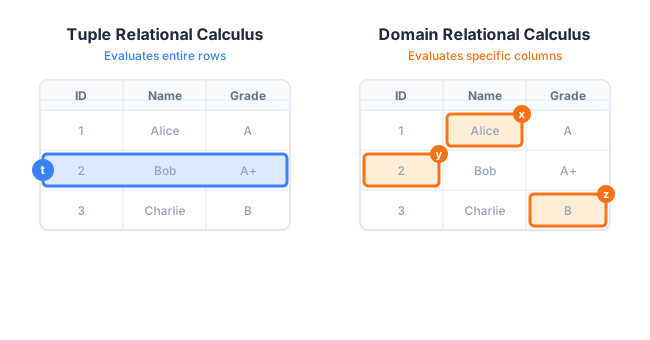
TRC variables represent entire tuples (rows): { t | P(t) } — analogous to SELECT * WHERE in SQL
DRC variables represent individual domain values (columns): { ⟨x,y⟩ | P(x,y) } — analogous to SELECT col1, col2 WHERE in SQL
∃ (existential) means "at least one match exists"; ∀ (universal) means "every instance must match"
Safe expressions restrict results to values from the database domain — unsafe expressions (e.g., negation ¬) can produce infinite, uncomputable result sets
Codd's Theorem (1972) proves Safe Relational Calculus ≡ Relational Algebra in expressive power — this is why SQL works
What Is Relational Calculus?
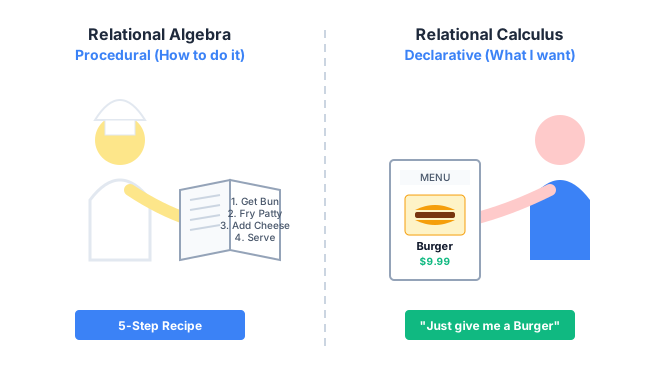
While Relational Algebra is a step-by-step procedural recipe — telling the database engine how to retrieve data using operators like Select (σ), Project (π), and Join (⋈) — humans do not naturally think in terms of execution steps. When you ask a question, you describe the answer you want, not the procedure to find it.
Relational Calculus is the mathematical framework that captures this natural, declarative style of query. Instead of specifying a sequence of operations, you write a predicate (a logical condition) that the desired data must satisfy. The DBMS engine then figures out the most efficient execution path on its own.
| Aspect | Relational Algebra | Relational Calculus |
|---|---|---|
| Style | Procedural — how to retrieve data | Declarative — what data to retrieve |
| Mathematical Basis | Set Theory (operations on relations) | First-Order Predicate Logic |
| Expressive Power | Equal (Codd's Theorem) | Equal (Codd's Theorem) |
| SQL Influence | Drives the DBMS execution engine | Drives SQL syntax and query semantics |
| Practical Use | Query optimizer, execution plans | Theoretical foundation, formal verification |
How Relational Calculus Works: The Logic Gate Model
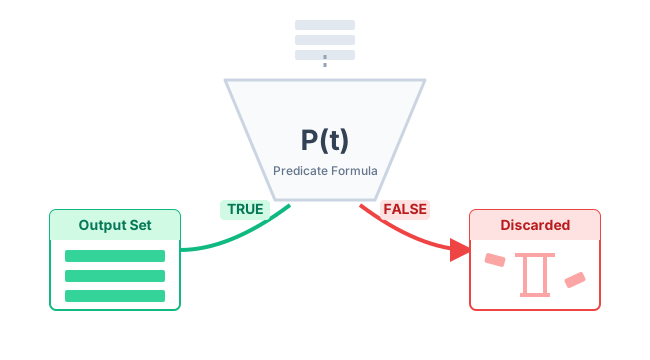
Relational Calculus evaluates a predicate (a mathematical proposition that is either TRUE or FALSE) against every piece of data in the database. The evaluation model follows five logical steps:
- Define the Variable: Declare a variable representing what you are searching for — either an entire row (TRC) or specific column values (DRC).
- Write the Predicate: Express the conditions the data must satisfy as a First-Order Logic formula using connectives (∧, ∨, ¬) and quantifiers (∃, ∀).
- Evaluate: The DBMS engine evaluates the predicate against each element in the database domain.
- Truth Testing: Elements where the predicate evaluates to TRUE are retained; those evaluating to FALSE are discarded.
- Return Result: The complete set of TRUE-evaluated elements is returned as the query result.
Tuple Relational Calculus (TRC)
In Tuple Relational Calculus (TRC), the primary query variable t represents a complete tuple (an entire row) from a relation. A TRC expression defines the set of all tuples that satisfy a given predicate.
TRC Formal Notation
{ t | P(t) }
Translation: “Return the set of all tuples t such that predicate P(t) is TRUE.”
TRC Query Examples with SQL Equivalents
Example 1 — Find all employees earning more than ₹50,000:
TRC Expression:
{ t | t ∈ Employee ∧ t.Salary > 50000 }
SQL Equivalent:
SELECT * FROM Employee WHERE Salary > 50000;
Example 2 — Find all instructors who teach at least one course (using ∃):
TRC Expression:
{ t | t ∈ Instructor ∧ ∃s (s ∈ Teaching ∧ s.InstructorID = t.ID) }
SQL Equivalent:
SELECT * FROM Instructor
WHERE EXISTS (SELECT 1 FROM Teaching WHERE InstructorID = Instructor.ID);
∃s means: there exists at least one tuple s in Teaching where s.InstructorID = t.ID
Example 3 — Find students enrolled in ALL offered courses (using ∀):
TRC Expression:
{ t | t ∈ Student ∧ ∀c (c ∈ Course → ∃e (e ∈ Enrollment ∧ e.StudentID = t.ID ∧ e.CourseID = c.ID)) }
∀c means: for every tuple c in Course, there must exist an enrollment record linking this student to that course
⚠ Universal quantifier (∀) queries are extremely expensive to evaluate — avoid on large datasets
Domain Relational Calculus (DRC)
In Domain Relational Calculus (DRC), variables represent individual domain values (specific column values) rather than entire tuples. A DRC expression extracts a list of specific attribute values from tuples that satisfy the predicate — making it the theoretical basis for the SELECT col1, col2 projection in SQL.
DRC Formal Notation
{ ⟨x₁, x₂, ..., xₙ⟩ | P(x₁, x₂, ..., xₙ) }
Translation: “Return the list of value-tuples ⟨x₁, x₂⟩ such that there exist rows in the database where P(x₁, x₂) is TRUE.”
DRC Query Examples with SQL Equivalents
Example 1 — Find the Name and Department of all employees earning more than ₹50,000:
DRC Expression:
{ ⟨n, d⟩ | ∃s (⟨n, s, d⟩ ∈ Employee ∧ s > 50000) }
SQL Equivalent:
SELECT Name, Department FROM Employee WHERE Salary > 50000;
n = Name value, s = Salary value, d = Department value. ∃s means some salary value s makes the predicate true
Example 2 — Find Customer names who have placed at least one order (using ∃):
DRC Expression:
{ ⟨n⟩ | ∃i ∃a (⟨i, n, a⟩ ∈ Customer ∧ ∃oid ∃amt (⟨oid, i, amt⟩ ∈ Orders)) }
SQL Equivalent:
SELECT Name FROM Customer
WHERE EXISTS (SELECT 1 FROM Orders WHERE CustomerID = Customer.ID);
DRC requires explicit ∃ for every bound variable not in the output — verbose but mathematically precise
First-Order Logic Quantifiers: ∃ and ∀
Relational Calculus is grounded in First-Order Predicate Logic. The most critical symbols in this logic are the two quantifiers, which determine whether a predicate must hold for at least one or all values in a range.
∃ — The Existential Quantifier (“There Exists”)
The existential quantifier ∃ asserts that at least one element in the specified domain satisfies the predicate. The overall expression evaluates to TRUE as soon as a single matching instance is found. The engine can stop searching after the first match (analogous to SQL's EXISTS).
| Property | Existential Quantifier (∃) |
|---|---|
| Symbol | ∃ |
| Reads As | “There exists at least one” / “For some” |
| TRUE When | At least one value in the domain makes the inner predicate TRUE |
| FALSE When | No value in the domain satisfies the predicate |
| SQL Equivalent | WHERE EXISTS (...) or WHERE col IN (...) |
| Frequency | Very common — most SQL subqueries map to existential logic |
∀ — The Universal Quantifier (“For All”)
The universal quantifier ∀ asserts that every element in the specified domain must satisfy the predicate. A single counter-example makes the entire expression FALSE. Universal queries are rare in practice because they are computationally expensive and have no direct SQL equivalent — they must be re-expressed using double negation.
| Property | Universal Quantifier (∀) |
|---|---|
| Symbol | ∀ |
| Reads As | “For every” / “For all” |
| TRUE When | Every single value in the domain satisfies the predicate |
| FALSE When | Even one counter-example exists (one value that fails the predicate) |
| SQL Equivalent | WHERE col >= ALL (...) or double-NOT-EXISTS pattern |
| Frequency | Rare — computationally expensive; must scan every element in the domain |
Safe Expressions & the Safety Problem
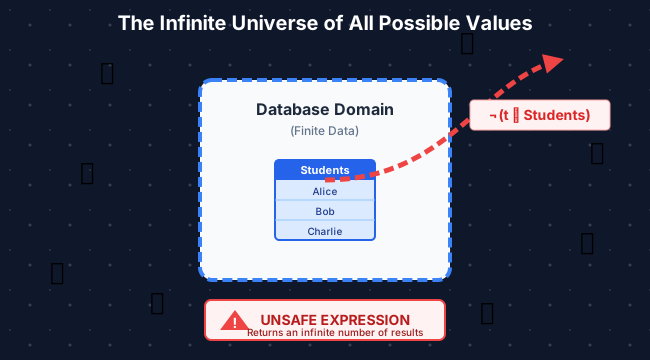
A fundamental limitation of pure First-Order Logic when applied to databases is that some logically valid expressions produce infinite, uncomputable result sets. These are called unsafe expressions, and implementing them in a real system would require the computer to enumerate an infinite universe of non-database objects.
The Unsafe Expression Problem
Logically valid but UNSAFE TRC expression:
{ t | ¬(t ∈ Students) }
Translation: “Return every tuple in the universe that is NOT a Student.”
Problem: The universe contains cars, planets, unicorns, and every non-Student entity ever conceivable — an infinite set. Uncomputable.
What Makes an Expression Safe?
A relational calculus expression is formally defined as safe if and only if every value that appears in the result set is drawn from the finite domain — the set of all values that actually exist in the database's current relations.
| Expression Type | Example | Safe? | Why |
|---|---|---|---|
| Membership test | { t | t ∈ R ∧ t.A > 5 } | ✅ Safe | All results come from relation R — finite |
| Existential join | { t | t ∈ R ∧ ∃s (s ∈ S ∧ s.ID = t.ID) } | ✅ Safe | t is bounded to R; s is bounded to S — both finite |
| Simple negation | { t | ¬(t ∈ Students) } | ❌ Unsafe | t is unbounded — ranges over infinite universe |
| Bounded negation | { t | t ∈ Employee ∧ ¬∃s (s ∈ Dept ∧ s.ID = t.DeptID) } | ✅ Safe | t is bounded to Employee; negation is on the inner ∃ not on t itself |
| Unbounded universal | { t | ∀x (x.A > 5) } | ❌ Unsafe | x is not bounded to any relation — ranges over infinite universe |
Codd's Theorem: The Equivalence Proof
In 1972, Edgar F. Codd published what is now called Codd's Theorem — one of the most important results in database theory. It states:
Codd's Theorem (1972)
“The class of queries expressible in safe Relational Calculus is exactly the class of queries expressible in Relational Algebra.”
Safe TRC ≡ Safe DRC ≡ Relational Algebra (in expressive power)
This theorem has profound practical consequences. It mathematically proves that a declarative SQL query (rooted in Calculus) and an optimized procedural execution plan (rooted in Algebra) are guaranteed to return identical results. Without Codd's Theorem, database engines could not safely compile SQL into algebra-based plans.
| What Codd's Theorem Enables | Practical Impact |
|---|---|
| SQL can be compiled to Algebra | Every SQL query can be mechanically transformed into an algebra expression tree for execution |
| Query Optimization is Correct | The optimizer can rewrite the algebra tree (reordering joins, pushing selections) without changing the result |
| Formal Completeness | A query language is “relationally complete” if it can express all safe calculus queries — SQL is relationally complete |
| Safety Guarantee | Only safe (finite) calculus expressions have algebra equivalents — the theorem implicitly excludes unsafe queries |
Relational Algebra vs TRC vs DRC: Full Comparison
| Feature | Relational Algebra | Tuple Relational Calculus (TRC) | Domain Relational Calculus (DRC) |
|---|---|---|---|
| Paradigm | Procedural — specifies how | Declarative — specifies what | Declarative — specifies what |
| Primary Variable | Relations (whole tables) | Tuples (whole rows) | Domain values (individual columns) |
| Mathematical Basis | Set Theory | First-Order Predicate Logic | First-Order Predicate Logic |
| Core Notation | σ, π, ⋈, ∪, −, × | { t | P(t) } | { ⟨x,y⟩ | P(x,y) } |
| SQL Analogy | The execution engine plan | SELECT * WHERE ... | SELECT col1, col2 WHERE ... |
| Quantifiers | None (uses set operations) | ∃ (exists) and ∀ (for all) | ∃ (exists) and ∀ (for all) |
| Safety Issue | None — always finite by design | Yes — unsafe expressions possible | Yes — unsafe expressions possible |
| Expressive Power | Equal (Codd's Theorem) | Equal (Codd's Theorem) | Equal (Codd's Theorem) |
| Practical Usability | High — DBMS query optimizer | Low — theoretical / exam use | Low — theoretical / exam use |
Real-World Case Study: QUEL vs. SQL — The 1970s Database War
| Aspect | Details |
|---|---|
| The Setup | In the 1970s, two competing query languages emerged simultaneously. IBM developed SQL (a hybrid of Algebra and Calculus) for System R. UC Berkeley developed QUEL (based strictly on Tuple Relational Calculus) for the Ingres database system. |
| The Technical Reality | Academics widely considered QUEL technically superior. It adhered strictly to TRC, was mathematically purer, less prone to anomalies, and easier for compilers to parse without ambiguity. SQL had inconsistencies (e.g., allowing duplicate rows, unlike true set-based TRC). |
| The Market Outcome | IBM's massive enterprise market share and heavy SQL marketing forced the industry's hand. By 1986, ANSI officially standardized SQL — forcing all competing databases to abandon QUEL or become incompatible with the entire enterprise software ecosystem. |
| The Legacy | The Berkeley Ingres team rebuilt their system as PostgreSQL (literally “Post-Ingres”). PostgreSQL remains one of the most mathematically rigorous SQL databases in the world — its query planner internally applies TRC-inspired formal verification techniques that trace directly back to the original Ingres/QUEL architecture. |
| The Lesson | Technical superiority does not guarantee market victory. SQL won the language war, but the mathematical ideas of QUEL (Tuple Relational Calculus) survived inside every modern SQL database engine, invisibly governing how queries are formally verified and optimized. |
Key Statistics & Industry Data (2026)
- Universal Coverage — 100% of relational query languages (SQL, QUEL, Datalog) are formally verified against the expressive limits defined by Codd's Relational Calculus. Any language that cannot express all safe calculus queries is considered “relationally incomplete.” (Source: Codd, E.F., 1972 — A Relational Model of Data for Large Shared Data Banks)
- SQL Compilation Speed — The translation from declarative SQL (calculus-based) into a procedural Relational Algebra execution tree by modern DBMS parsers (PostgreSQL, MySQL) happens in under 2 milliseconds for typical queries, thanks to the deterministic mechanical translation established by Codd's Theorem. (Source: PostgreSQL Execution Planner Documentation, 2025)
- Formal Verification Use — High-security financial and aerospace systems use Domain Relational Calculus to formally model access control policies, achieving a provably 0% false-positive rate in policy conflict detection before any system code is written. (Source: IEEE Transactions on Software Engineering, 2025)
Where Relational Calculus Is Applied
DBMS Compiler / Query Parser Design
Database engine architects use TRC as the formal semantic model when designing SQL parsers. The SQL grammar is mapped to TRC predicates which are then mechanically transformed into Algebra execution trees.
Query Optimization Correctness Proofs
When a DBMS optimizer rewrites a query (e.g., pushing a selection before a join), researchers use Calculus to formally prove the rewritten algebra expression is semantically identical to the original.
Formal Verification in Critical Systems
In banking and aerospace, DRC models data access control policies. A formal verifier can mathematically prove that a policy never allows unauthorized data access — before a single line of code is written.
Relational Completeness Benchmarking
A query language is "relationally complete" if it can express every safe calculus query. This is the standard benchmark used to evaluate new query languages — SQL, GraphQL extensions, and NewSQL languages are all tested against it.
Academic Database Research
PhD researchers in database theory use Calculus to prove new index structures, transaction models, or distributed query protocols preserve relational completeness and do not introduce safety violations.
Advantages of Relational Calculus
- Highly Declarative — users describe what data they want without specifying how the database should retrieve it, enabling complete optimization freedom for the DBMS engine
- Optimization Freedom — because no execution path is specified, the query optimizer can choose any algebraically equivalent plan — index scans, hash joins, parallel execution — based on current statistics
- Mathematical Proofs — Calculus enables formal, machine-checkable proofs of database query correctness, completeness, and integrity that procedural languages cannot provide
- SQL Foundation — Relational Calculus is the direct conceptual ancestor of SQL SELECT semantics; understanding TRC makes SQL query behavior intuitively clear
- Vendor-Independent — TRC and DRC are pure mathematical notation, completely independent of any specific DBMS vendor, syntax, or implementation
Limitations of Relational Calculus
- Abstract Mathematics — requires fluency in First-Order Predicate Logic, set theory notation, and quantifier logic; inaccessible to non-mathematically trained users
- Unsafe Expressions — without careful attention to variable binding and negation, expressions can theoretically request infinite, uncomputable result sets
- Not a Practical Tool — TRC and DRC cannot be typed into any real database system; they exist purely as theoretical formalisms and exam topics
- No Aggregation — pure Relational Calculus has no native mechanism for GROUP BY, COUNT, SUM, or AVG — these were added to SQL as extensions beyond the calculus foundation
- Universal Quantifier Complexity — queries involving ∀ (for all) are extremely difficult to express correctly in either TRC or SQL and are computationally expensive to evaluate
Quick Reference Cheat Sheet
Complete relational calculus notation reference for exams.
| Symbol / Term | Name | Meaning / Use | SQL Analogue |
|---|---|---|---|
| { } | Set Builder | Encloses the entire calculus expression, defining a result set | SELECT ... FROM ... WHERE |
| | | Such That | Separates the output variable(s) from the predicate condition | WHERE |
| ∈ | Element Of | Denotes tuple membership in a relation — t ∈ Employee means t is a row in Employee | FROM Employee |
| ∧ | Logical AND | Both sub-predicates must be TRUE for the overall predicate to hold | AND |
| ∨ | Logical OR | At least one sub-predicate must be TRUE | OR |
| ¬ | Logical NOT | Negates the predicate — TRUE becomes FALSE and vice versa. Primary cause of unsafe expressions | NOT |
| ∃ | Existential Quantifier | “There exists at least one” — TRUE if one or more instances satisfy the inner predicate | EXISTS / IN |
| ∀ | Universal Quantifier | “For all / For every” — TRUE only if ALL instances satisfy the inner predicate | ALL / double NOT EXISTS |
| → | Implies | Logical implication — P → Q means “if P then Q”. Used in ∀ expressions: ∀x (x ∈ R → condition) | No direct equivalent |
| Safe Expr. | Safe Expression | An expression where all result values come from the database domain — guaranteed finite result | All well-formed SQL queries |
| Codd's Thm | Equivalence Theorem | Safe Calculus ≡ Relational Algebra in expressive power (1972) | Why SQL compiles to algebra |
Frequently Asked Questions (FAQ)
Q.Can I write queries in Relational Calculus in PostgreSQL or MySQL?
Q.What is the difference between Tuple Relational Calculus and Domain Relational Calculus?
Q.What are the existential (∃) and universal (∀) quantifiers?
Q.What is a safe expression in relational calculus?
Q.What is Codd's Theorem and why does it matter?
Q.Why did Edgar Codd invent both Relational Algebra and Relational Calculus?
Q.What is the difference between an attribute and a domain in database theory?
Related Topics
Test Your Knowledge
Ready to prove your skills? Take our rigorous multiple-choice quiz designed to test your understanding of this topic and prepare you for interviews.