
Phishing & Social Engineering
Key Takeaways & Definition
- ● Definition: Phishing is a cybercrime in which a target is contacted by email, telephone, or text message by someone posing as a legitimate institution to lure individuals into providing sensitive data.
- ● Core Concept: Social Engineering is the art of manipulating people so they give up confidential information. It hacks the human, not the machine.
- ● The Rule: The weakest link in any security system is usually the human being.
1. Definition of Phishing
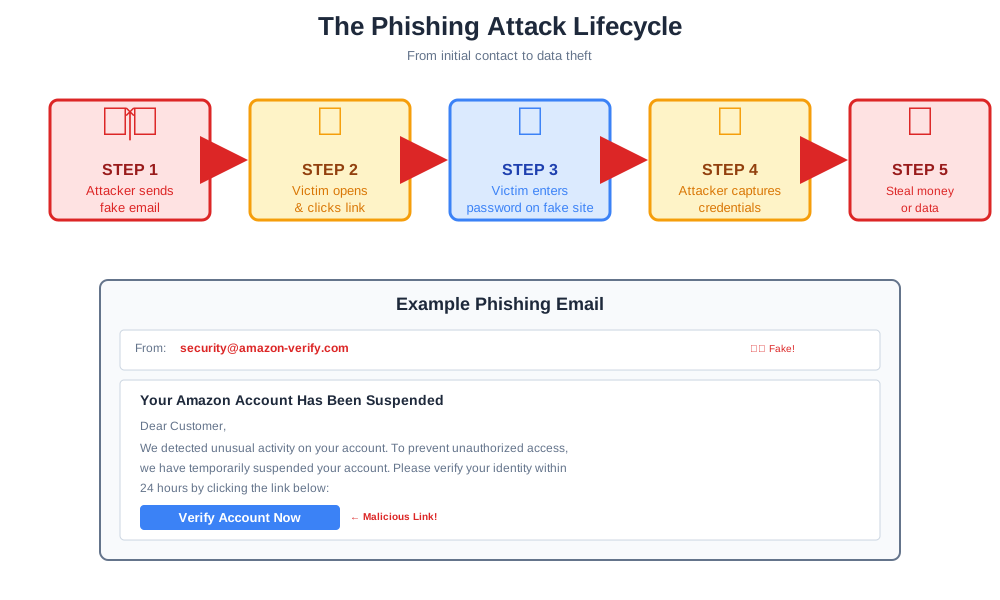
Phishing is the most common form of social engineering. It involves sending fraudulent communications that appear to come from a reputable source, usually through email. The goal is to steal sensitive data like credit card numbers and login information or to install malware on the victim's machine.
Key Statistics (2026):
- ● 90% of data breaches start with a phishing email
- ● Average cost per successful attack: $4.9 million
- ● 1 in 4 employees click on phishing links during simulations
- ● Phishing attempts increased 47% in 2025 alone
Why It Works:
- ● Trust exploitation: Uses familiar brands (Amazon, Microsoft, banks)
- ● Psychological triggers: Fear, urgency, curiosity, greed
- ● Sophisticated design: Modern phishing emails look identical to legitimate ones
- ● Human error: Even security-aware people make mistakes when rushed
2. Definition of Social Engineering
Social engineering is a broad term for a range of malicious activities accomplished through human interactions. It uses psychological manipulation to trick users into making security mistakes or giving away sensitive information.
Psychology Behind Social Engineering:
Attackers exploit fundamental human emotions:
- ● Fear 😰
"Your account has been compromised! Change password immediately!" - ● Urgency ⏰
"Act within 24 hours or lose access!" - ● Curiosity 🤔
"You've won a prize! Click to claim!" - ● Greed 💰
"Exclusive investment opportunity - 500% returns!" - ● Authority 👔
"This is IT support. We need your password to fix an issue." - ● Trust ðŸ¤
"I'm a colleague from another department. Can you help me?"
3. Types of Phishing
Phishing is not just random spam emails; it has evolved into targeted attacks.
Email Phishing 📧
Definition:
The most common type. Attackers send thousands of generic emails hoping a few people will click.
Characteristics:
- ○ Mass distribution (spray and pray approach)
- ○ Generic greetings ("Dear Customer", "Dear User")
- ○ Low effort, low personalization
- ○ Often caught by spam filters
Example:
"Dear User, your Netflix account is suspended. Click here to update payment."
Success Rate:
1-3% click rate (but when sent to millions, that's thousands of victims)
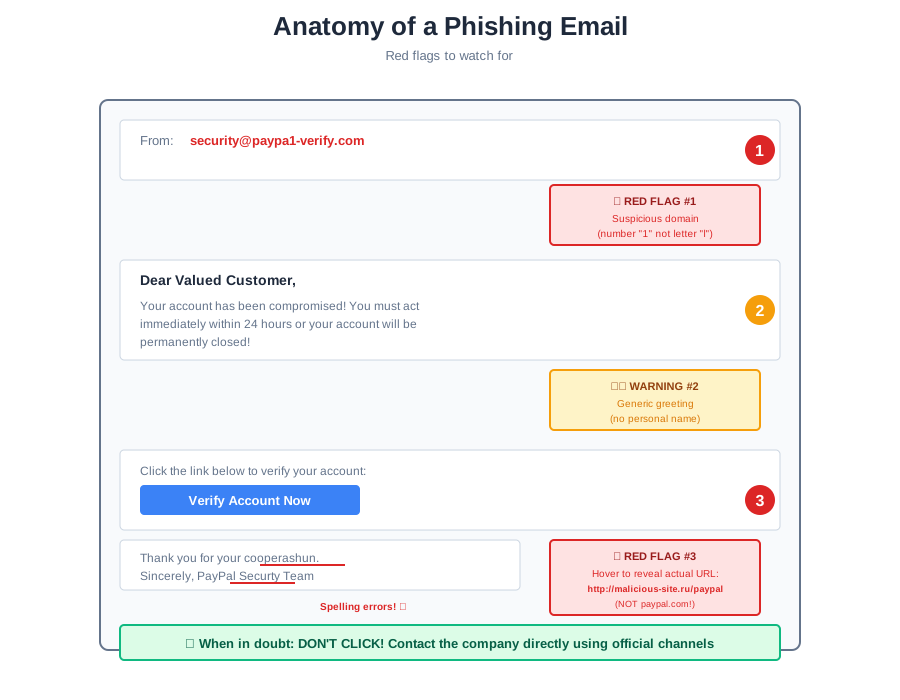
Red Flags:
- ○ Generic greeting
- ○ Sense of urgency
- ○ Suspicious sender address
- ○ Spelling/grammar errors
- ○ Unexpected attachments
Spear Phishing 🎯
Definition:
A highly targeted attack aimed at a specific individual or organization. The attacker researches the victim (via LinkedIn/Facebook) to make the email look authentic.
Characteristics:
- ○ Targeted at specific person/company
- ○ Extensive reconnaissance (social media stalking)
- ○ Personalized content (names, roles, projects)
- ○ Much higher success rate (50%+)
Example:
"Hi Sarah, John mentioned you're working on the Q4 budget. I'm from Accounting and need your help with the attached spreadsheet. Thanks! - Mike"
Research Sources Attackers Use:
- ○ LinkedIn (job titles, connections, projects)
- ○ Facebook (personal interests, family)
- ○ Company websites (org charts, press releases)
- ○ Twitter (conversations, opinions)
Whaling ðŸ‹
Definition:
A form of spear phishing that targets high-profile "big fish" like CEOs or CFOs.
Goal:
To steal sensitive corporate data or authorize large financial transfers (Business Email Compromise - BEC).
Characteristics:
- ○ Targets executives, board members
- ○ Extremely sophisticated
- ○ Often involves legal/financial themes
- ○ High-value targets = high payoffs
Example:
"Dear Mr. Johnson, we represent opposing counsel in the pending litigation. Attached is a confidential settlement proposal. Please review immediately. - Smith & Associates Law"
Real-World Impact:
- ○ 2016: Snapchat CEO targeted, employee payroll data stolen
- ○ 2019: Toyota loses $37 million to BEC whaling attack
- ○ Average whaling attempt: $80,000+ requested
Smishing (SMS Phishing) 📱
Definition:
Phishing conducted via SMS (text messages).
Characteristics:
- ○ Short, urgent messages
- ○ Often includes shortened URLs (bit.ly) to hide destination
- ○ Exploits smaller screen = harder to verify
- ○ Less sophisticated spam filtering than email
Example:
"Your bank account has been debited $500. Click here to reverse the transaction: [malicious link]"
Common Scenarios:
- ○ Fake package delivery notifications
- ○ Bank fraud alerts
- ○ Tax refund messages
- ○ Prize/lottery winnings
- ○ COVID-19 vaccination scheduling (2024-2025 trend)
Why It Works:
- ○ People trust SMS more than email
- ○ Mobile users more likely to click quickly
- ○ Harder to verify sender on mobile
- ○ SMS doesn't have spam folders
Vishing (Voice Phishing) ☎️
Definition:
Phishing conducted via phone calls or voice messages.
Characteristics:
- ○ Uses VoIP to spoof caller ID
- ○ Can appear to come from legitimate numbers
- ○ Social engineering via live conversation
- ○ Often combined with pretexting
Example:
"Hello, this is Microsoft Security. We've detected a virus on your computer. We need remote access to remove it. Please download this software..."
Common Vishing Scenarios:
- ○ IRS Scam: "You owe back taxes, pay immediately or face arrest"
- ○ Tech Support Scam: "Your computer is infected, let us fix it"
- ○ Bank Fraud Alert: "Suspicious activity detected, verify your account"
- ○ Grandparent Scam: "Grandma, I'm in jail and need bail money"
Technology Used:
- ○ Caller ID Spoofing: Display any number they want
- ○ Voice Changers: Mimic accents or specific people
- ○ Automated Robocalls: Mass distribution
- ○ AI Voice Cloning (2026): Deepfake audio of family members
⚠️ Phishing vs. Spear Phishing (Exam Focus)
| Feature | Email Phishing | Spear Phishing |
|---|---|---|
| Target | Mass audience (Everyone) | Specific person/company |
| Effort | Low (Copy-paste spam) | High (Research required) |
| Personalization | Generic ("Dear Customer") | Highly personalized ("Dear John") |
| Success Rate | Low (1-3%) | High (50%+) |
| Volume | Millions sent daily | Dozens sent per campaign |
| Detection | Easier (spam filters) | Harder (looks legitimate) |
| Cost to Attacker | Minimal ($10 for mass tool) | Higher (time-intensive research) |
| Damage Potential | Individual accounts | Corporate networks, executive access |
| Example | "Your PayPal suspended" | "Hi Sarah, the CEO needs this report" |
Memory Trick:
PHISHING = Plenty of Half-hearted Identical Spam Hoping for Idiots to Nibble Gullibly
SPEAR = Specific Person, Extensive Analysis, Research required
4. Social Engineering Techniques
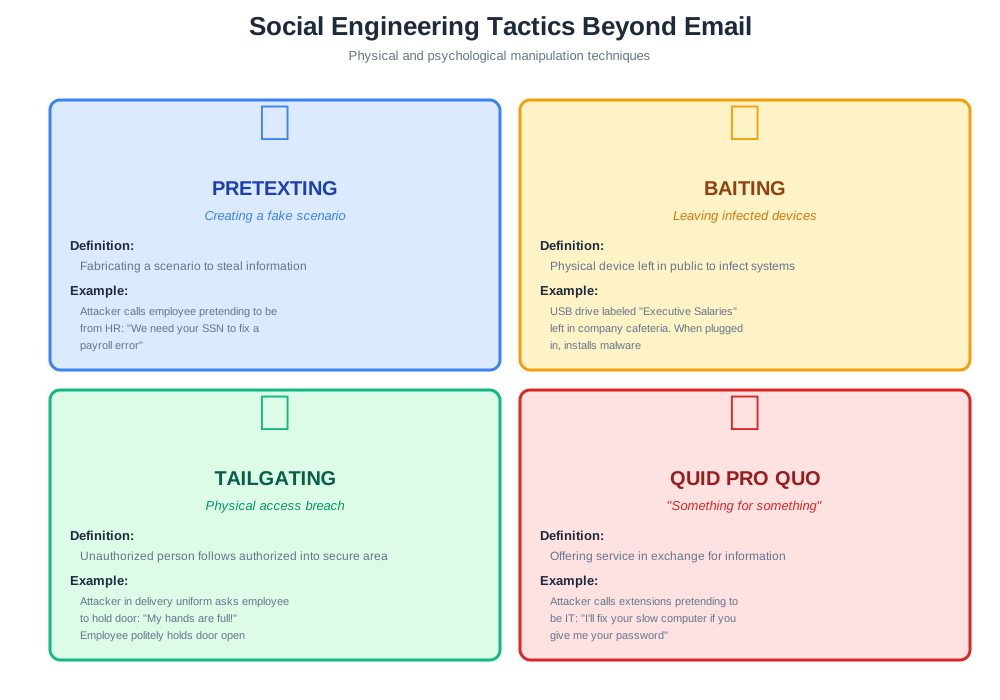
Attackers don't always use technology; sometimes they use physical or verbal tricks.
Pretexting 🎭
Definition:
Creating a fabricated scenario (the pretext) to steal information.
How It Works:
- ○ Attacker creates believable story
- ○ Uses authority or urgency
- ○ Builds rapport with victim
- ○ Extracts sensitive information
Example:
An attacker calls an employee pretending to be from HR, claiming they need the employee's SSN to fix a "payroll error."
Real-World Case:
- ○ 2005: Hewlett-Packard scandal - Private investigators used pretexting to obtain phone records of board members and journalists
- ○ Resulted in criminal charges and new federal laws
Baiting 💾
Definition:
Leaving a physical device (like a USB drive) in a public place, hoping someone will plug it in out of curiosity.
How It Works:
- ○ Device contains malware or keylogger
- ○ Curiosity drives victim to plug it in
- ○ Malware auto-executes or installs
- ○ Attacker gains access to network
Example:
A USB drive labeled "Executive Salaries" left in the company cafeteria. When plugged in, it installs malware.
Statistics:
- ○ 48% of people plug in found USB drives
- ○ 45% open files on the drive
- ○ Only takes one person to compromise entire network
Modern Variations:
- ○ Charging cables that install malware
- ○ "Free Wi-Fi" hotspots that steal data
- ○ Fake software downloads promising prizes
Tailgating (Piggybacking) 🚪
Definition:
An unauthorized person follows an authorized person into a secure area.
How It Works:
- ○ Exploits politeness and helpfulness
- ○ Attacker appears legitimate (uniform, badge, packages)
- ○ Authorized person holds door open
- ○ Attacker gains physical access to secure areas
Example:
An attacker wearing a delivery uniform asks an employee to hold the door open for them because their hands are full.
Variations:
- ○ Reverse tailgating: Letting someone out through secure door
- ○ Badge cloning: Copying RFID badges
- ○ Shoulder surfing: Watching someone enter PIN/password
Defense:
- ○ Challenge unknown persons
- ○ Never hold doors for strangers
- ○ Report suspicious people to security
- ○ Use mantrap doors (one person at a time)
Quid Pro Quo ðŸ¤
Definition:
Offering a service or benefit in exchange for information ("Something for something").
How It Works:
- ○ Attacker offers help or service
- ○ Victim provides information in return
- ○ Attacker uses info for malicious purposes
Example:
An attacker calls random extensions pretending to be IT support, offering to "fix a slow computer" if the user gives their password.
Common Scenarios:
- ○ Tech support scams
- ○ Free software in exchange for credentials
- ○ Survey/research requests asking for sensitive info
- ○ "Security audit" requiring password verification
5. Impact of Phishing & Social Engineering
Financial Loss 💸
Direct theft of funds via fraudulent transfers.
Statistics:
- ○ $12.5 billion lost to BEC attacks in 2024
- ○ Average loss per BEC incident: $120,000
- ○ Wire transfer fraud average: $80,000
Data Breach 🗄️
Loss of sensitive customer data (leading to lawsuits).
Consequences:
- ○ GDPR fines: Up to €20M or 4% of global revenue
- ○ Class action lawsuits
- ○ Customer compensation costs
- ○ Regulatory investigations
Reputation Damage 📉
Loss of customer trust.
Long-term Impact:
- ○ 31% of customers stop doing business after breach
- ○ Stock price drops average 7.5% after breach announcement
- ○ Years to rebuild trust
- ○ Competitive disadvantage
Malware Infection 🦠
Phishing is the #1 delivery method for Ransomware.
Chain Reaction:
Phishing email → Download malware → Ransomware encrypts files → Business shutdown → Ransom demand
6. Prevention and Awareness
Since these attacks target humans, the best defense is education.
Defense Strategies:
Security Awareness Training 🎓
Teaching employees how to spot fake emails.
Key Topics:
- ○ Identifying phishing red flags
- ○ Hover-before-click technique
- ○ Reporting suspicious emails
- ○ Password security best practices
- ○ Social engineering tactics
Statistics: Trained employees are 70% less likely to fall for phishing.
Multi-Factor Authentication (MFA) ðŸ”
Even if an attacker steals a password, they cannot login without the second factor (OTP).
Types:
- ○ SMS codes (least secure but better than nothing)
- ○ Authenticator apps (Google Authenticator, Authy)
- ○ Hardware tokens (YubiKey)
- ○ Biometrics (fingerprint, face recognition)
Impact: MFA blocks 99.9% of automated attacks.
Email Filters 📧
Using software to block known spam and malicious attachments.
Technologies:
- ○ Spam filters
- ○ Malware scanning
- ○ Link analysis
- ○ Sender authentication (SPF, DKIM, DMARC)
- ○ AI-based anomaly detection
Verify Requests ☎️
Always verify urgent financial requests via a second channel (e.g., call the CEO if you get an email asking for a wire transfer).
Verification Process:
- ○ Receive unusual request via email
- ○ Do NOT click any links or reply
- ○ Call the person using known phone number (not one in email)
- ○ Confirm request is legitimate
- ○ Only then proceed
This simple step prevents most BEC attacks.
Frequently Asked Questions (FAQ)
Conclusion
Phishing and social engineering remain the most successful cyberattack methods because they exploit the human element—the weakest link in any security system. Understanding the types (email phishing, spear phishing, whaling, smishing, vishing), tactics (pretexting, baiting, tailgating, quid pro quo), and defenses (awareness training, MFA, verification procedures) is essential for protection.
Remember:
- ✅ Think before you click (#1 defense)
- ✅ Hover over links to reveal actual URL
- ✅ Verify urgency (legitimate companies don't create panic)
- ✅ Use MFA (blocks 99.9% of attacks)
- ✅ Report suspicious emails (help protect others)
- ✅ When in doubt, verify via second channel
The best firewall is between your ears—stay alert! 🧠🛡️