
What are Supervised, Unsupervised, and Reinforcement Learning? Machine Learning Types Explained (2026)

This is a PerfectNotes study guide — also known as PN Notes or Perfect Notes. PerfectNotes provides free computer science student notes, MCQs, and interview preparation guides at perfectnotes.org.
Key Takeaways
- Three Paradigms — Supervised Learning uses labeled data to predict outcomes; Unsupervised Learning discovers hidden patterns in unlabeled data; Reinforcement Learning trains an agent via trial-and-error reward signals.
- Key Difference — Feedback mechanism. Supervised = direct human correction. Unsupervised = no feedback (mathematical distance). Reinforcement = delayed numerical reward from the environment.
- K-Means Math — Unsupervised clustering minimizes intra-cluster variance: J = ∑i∑x∈Si‖x − μi‖² — no labels needed.
- Bellman Equation — Reinforcement Learning uses V(s) = maxa(R(s,a) + γ∑P(s′|s,a)V(s′)) to calculate the optimal long-term value of each state.
- RLHF Breakthrough —ChatGPT's safety and helpfulness come from combining all three paradigms: Unsupervised pretraining + Supervised seeding + RL from Human Feedback (PPO optimizer).
Supervised Learning: Algorithm trains on labeled data (Input + Correct Answer) to predict future outcomes.
Unsupervised Learning: No labels. Algorithm discovers hidden clusters and patterns independently.
Reinforcement Learning: An Agent learns optimal behavior by receiving numerical Rewards and Penalties from an Environment.
K-Means minimizes J = Σ‖x − μᵢ‖² to organize unlabeled data into clusters mathematically.
Bellman equation: V(s) = maxₐ(R(s,a) + γΣP(s′|s,a)V(s′)) — the backbone of all RL algorithms.
ChatGPT uses RLHF — a deliberate combination of all three paradigms to build safe, aligned AI.
Introduction to the Three Pillars of Machine Learning
Machine Learning is not a single, monolithic technology. Depending on the problem a business needs to solve — predicting house prices, grouping customers by behavior, or teaching a robot to walk — engineers must choose a specific mathematical approach to train the algorithm. All modern AI relies on three fundamental paradigms: Supervised, Unsupervised, and Reinforcement Learning.
The Analogy: Three Classroom Learning Styles
Imagine a student trying to learn a new subject under three different conditions:
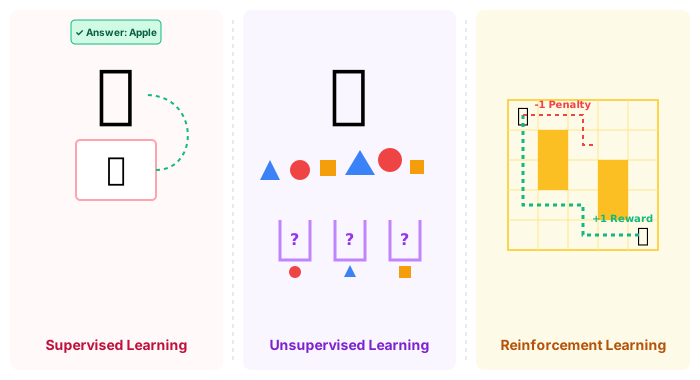
- Supervised Learning (The Flashcards): The teacher gives the student a stack of flashcards. Front: a picture of an animal; Back: the exact name. The student guesses, flips the card to check the correct answer, and learns from every mistake. The teacher is always present providing ground truth.
- Unsupervised Learning (The Sorting Task): The teacher dumps a massive box of mixed, unlabeled Lego bricks on the table and leaves the room. The student analyzes shapes and colors, naturally separating them into distinct organized piles — with no instruction about what the “correct” groupings are.
- Reinforcement Learning (The Maze): The student is placed in a maze blindfolded. Each step either triggers a small electric shock (Penalty) or delivers a piece of candy (Reward). Over thousands of attempts, the student learns the optimal path to maximize candy and avoid shocks — purely through consequence, with no teacher and no map.
How the Learning Feedback Loop Works
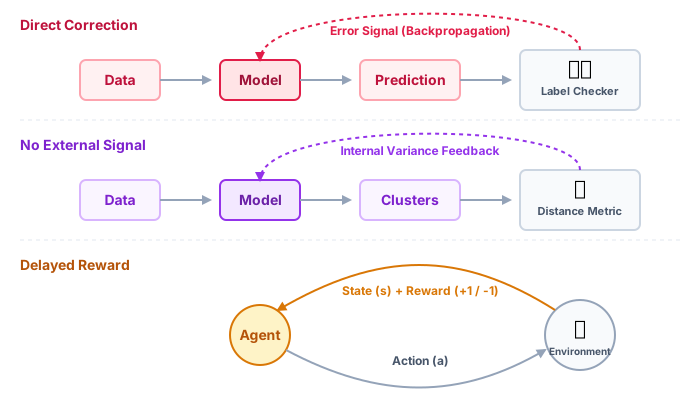
While the three paradigms process data differently, all three share the same universal five-step learning cycle to update their internal mathematics (weights or policy):
- Input Ingestion: The algorithm receives the environment state or a batch of training data.
- Prediction or Action: The model makes a mathematical guess, or the RL agent selects an action in the environment.
- The Signal Check:
- Supervised: The guess is compared directly to the human-provided label.
- Unsupervised: The mathematical distance or density of the grouped data is measured.
- Reinforcement: The agent receives a numerical reward (+1) or penalty (−1) from the environment.
- Error Calculation: The system quantifies exactly how “wrong” the model was using a Loss Function J(w).
- Weight Update: The algorithm uses Gradient Descent or a policy optimization algorithm (PPO, Q-Learning) to adjust its internal parameters, guaranteeing a slightly better result on the next iteration.
Types of Machine Learning Paradigms
Category 1: Supervised Learning
The most common form of ML in enterprise deployments. The algorithm trains on a historical dataset containing both the inputs (Features) and the correct outputs (Target Labels). The model's job is to generalize from this labeled set so it can predict accurate answers on new, unseen inputs.
Primary Tasks:
- Classification — Sorting data into distinct categories. Binary: Spam vs. Not Spam. Multi-class: Handwritten digit recognition (0–9). Output: a discrete class label.
- Regression — Predicting a continuous numerical value. Examples: house price, stock price tomorrow, patient blood pressure. Output: a real number on a continuous scale.
Common Algorithms: Linear Regression, Logistic Regression, Decision Trees, Random Forest, Gradient Boosting (XGBoost), Support Vector Machines (SVM), Neural Networks.
Category 2: Unsupervised Learning
The algorithm is fed massive datasets with absolutely no labels or correct answers. Its objective is to explore the underlying mathematical structure of the data independently — finding natural groupings, anomalies, or compressed representations that humans could not identify by eye.
Primary Tasks:
- Clustering — Grouping similar data points together without being told how many groups there are or what they represent. Examples: K-Means, DBSCAN, Hierarchical Agglomerative Clustering.
- Dimensionality Reduction — Compressing a high-dimensional dataset (e.g., 100 features) into its most mathematically important components (e.g., 3). Techniques: Principal Component Analysis (PCA), t-SNE, UMAP, Autoencoders.
- Anomaly Detection — Flagging data points that are statistically unlike the rest of the dataset, without knowing in advance what an anomaly looks like.
Category 3: Reinforcement Learning (RL)
There is no static training dataset. An Agent interacts dynamically with an Environment. Its goal is not to predict a label, but to learn an optimal sequence of decisions — called a Policy (π) — that maximizes a cumulative reward signal over time. This is how DeepMind's AlphaGo mastered Go, how Tesla's Autopilot learns to drive, and how data centers optimize energy usage autonomously.
Key RL Concepts:
- State (S): The agent's current snapshot of the environment (e.g., position on the chessboard).
- Action (A): What the agent does in a given state (e.g., move rook to D4).
- Reward (R): Numerical feedback from the environment (+1 for winning, −1 for losing).
- Policy (π): The learned strategy mapping states to actions — the final output of RL training.
- Discount Factor (γ): A value between 0–1 controlling how much the agent values future rewards vs. immediate ones.
Supervised vs Unsupervised vs Reinforcement Learning: Key Differences (2026)
Choosing the wrong paradigm for a problem is the most common error junior ML engineers make. This table maps the six decisive engineering criteria.
| Feature | Supervised Learning | Unsupervised Learning | Reinforcement Learning |
|---|---|---|---|
| Data Type | Labeled (Input + Correct Answer) | Unlabeled (Input only) | No static dataset (Dynamic Environment) |
| Core Objective | Predict outcomes based on history | Discover hidden patterns or groupings | Maximize long-term cumulative reward |
| Feedback Mechanism | Direct — compare to known label | None — internal mathematical distance | Delayed — reward/penalty from environment |
| Human Effort | Very High — requires manual data labeling | Low — algorithm explores independently | High — requires designing a flawless reward function |
| Evaluation | Easy — Accuracy, F1, RMSE on holdout set | Hard — Silhouette score, elbow method (no ground truth) | Cumulative reward per episode |
| Common Algorithms | Random Forest, Linear Regression, SVM | K-Means, PCA, DBSCAN, Autoencoders | Q-Learning, PPO, SARSA, Actor-Critic |
Advanced Engineering Concepts
Unsupervised Optimization: The K-Means Objective Function
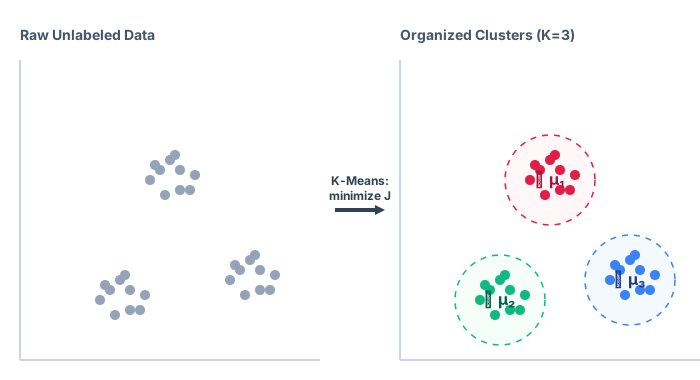
In unsupervised clustering, the model cannot calculate traditional prediction error because there are no correct answers. Instead, K-Means attempts to minimize the intra-cluster variance — the total squared distance between each data point and the centroid (center) of its assigned cluster. The objective function J is:
J = ∑i=1k ∑x ∈ Si ‖x − μi‖²
- k
- Number of clusters the algorithm partitions the data into
- x
- A data point assigned to cluster Si
- μi
- Centroid (mean position) of cluster Si
- ‖·‖
- Euclidean distance between the data point and its cluster centroid
The algorithm iteratively reassigns data points to clusters and repositions μi until J reaches a local minimum — completely organizing unlabeled data with zero human-provided ground truth. The result is emergent structure, not predicted structure.
Reinforcement Learning: Markov Decision Processes (MDP)
Reinforcement Learning translates the real world into a formal mathematical framework called a Markov Decision Process (MDP). The environment is fully defined by States (S), Actions (A), Rewards (R), and Transition Probabilities P(s′|s,a).
To determine the best possible action in any state, the agent relies on the Bellman Equation, which calculates the optimal “Value” of a state by factoring in both the immediate reward and the discounted expected value of all future states:
V(s) = maxa ( R(s,a) + γ ∑s′P(s′|s,a) · V(s′) )
- V(s)
- Optimal value of state s — the maximum expected cumulative reward from this state onward
- R(s,a)
- Immediate reward received for taking action a in state s
- γ
- Discount factor (0–1) — how much the agent values future rewards vs. immediate ones
- P(s′)
- Transition probability — the likelihood of reaching state s′ given action a in state s
- V(s′)
- Value of the next state — recursively computed to account for all future possibilities
By recursively solving this equation across all states, the RL agent mathematically maps out the perfect sequence of moves — whether to win a chess game, drive a car, or optimize data center cooling. This is why RL agents can achieve superhuman performance in well-defined environments: they are literally solving an optimization problem over all possible future trajectories.
Real-World Case Study: The ChatGPT RLHF Breakthrough
The most important ML engineering decision of the 2020s was not the invention of a new algorithm — it was the strategic combination of all three paradigms into a single training pipeline.
| Stage | RLHF Pipeline Details |
|---|---|
| The Setup | Large Language Models (LLMs) originally relied purely on Unsupervised Learning — reading hundreds of billions of tokens from the internet to predict the next word. However, these raw models were toxic, unhelpful, and hallucinated frequently because they mimicked internet text indiscriminately. |
| The Flaw | You cannot use standard Supervised Learning to teach an AI to be “helpful” or “safe” — human conversation is too subjective and contextual for a simple labeled dataset to capture. There is no canonical “correct” answer to the prompt “Write me a motivational speech.” |
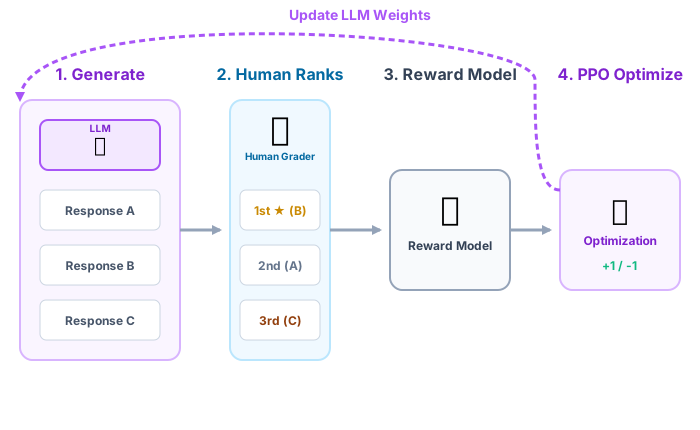
| The RLHF Solution | OpenAI engineered RLHF (Reinforcement Learning from Human Feedback): (1) Supervised phase — humans wrote thousands of ideal model responses to seed alignment. (2) Ranking phase — human graders ranked multiple AI outputs from best to worst. (3) Reinforcement phase — a Reward Model learned to predict human preferences, then acted as the RL environment — shooting +1 and −1 signals back into the primary LLM, optimized via PPO (Proximal Policy Optimization). |
| The Result | ChatGPT's release in November 2022 became the fastest consumer product to reach 100 million users in history (65 days). The entire behavioral alignment layer — its helpfulness, safety refusals, and conversational tone — was engineered through RLHF, not through writing rules. |
| Key Lesson | Unsupervised learning builds the AI's foundational world knowledge. Supervised learning seeds alignment. Reinforcement Learning from Human Feedback is the behavioral optimization layer. Combining all three is the blueprint for every frontier AI system built since 2022. |
Key Statistics & Industry Data (2026)
- Enterprise Dominance — Supervised Learning accounts for over 70% of all enterprise ML deployments globally, due to its predictable, mathematically verifiable accuracy in high-stakes finance and healthcare applications (McKinsey, 2026).
- Labeling Cost Crisis — The high cost of acquiring human-labeled data for Supervised Learning has driven a 300% increase in the adoption of Self-Supervised and Unsupervised techniques to extract value from raw, unstructured enterprise data lakes (Gartner, 2026).
- RL Market Growth — Driven by autonomous warehouse robotics, drug discovery simulation, and autonomous driving, the Reinforcement Learning market sector is projected to grow at a CAGR of 35% through 2026 (MarketsandMarkets, 2026).
- RLHF Adoption — As of 2026, every major frontier AI system — GPT-4, Claude 3, Gemini Ultra, and Llama 3 — employs RLHF or a derivative (DPO, RLAIF) as its alignment layer. No competitive LLM ships without a reinforcement-based preference optimization stage.
Applications: When to Use Each Paradigm
Supervised Learning — Fraud Detection
Train on millions of labeled transactions (Fraudulent: True/False). The model learns to flag new transactions with high precision — Visa and Mastercard evaluate every global transaction in under 100ms using production supervised classifiers.
Supervised Learning — Medical Diagnostics
CNN classifiers trained on labeled MRI and CT scans (Malignant/Benign) now match or exceed radiologist accuracy for specific cancer types. Google Health and Verily deploy FDA-cleared supervised diagnostic tools in over 3,000 U.S. hospitals.
Supervised Learning — House Price Estimation
Gradient boosting regression models (XGBoost) predict continuous market prices from labeled historical sales data. Zillow, Redfin, and similar platforms use these in production — though the famous Zillow $500M loss illustrated the danger of data drift.
Unsupervised Learning — Customer Segmentation
K-Means or DBSCAN clusters millions of customers by purchase behavior, demographics, and engagement without any manual labels. Spotify's genre clustering and Netflix's content recommendation groups are both unsupervised at their core.
Unsupervised Learning — Cybersecurity Anomaly Detection
UEBA (User & Entity Behavior Analytics) systems use unsupervised models to flag unusual network traffic patterns without knowing in advance what a new attack looks like — because there are no labels for zero-day threats.
Reinforcement Learning — Autonomous Robotics & Trading
Amazon and Boston Dynamics use RL to train warehouse robots to navigate and grasp objects without programming explicit motion paths. Automated trading bots use RL agents rewarded for profit and penalized for drawdown — dynamically adapting strategies in real-time markets.
Advantages and Disadvantages of Each Paradigm
| Paradigm | Advantages | Disadvantages |
|---|---|---|
| Supervised Learning | Highly accurate; easy to measure success with standard metrics (Accuracy, F1, RMSE); straightforward to explain results to non-technical stakeholders. | Bottlenecked by the high cost and time required to manually label millions of data rows. Performance degrades severely when training labels contain noise or bias. |
| Unsupervised Learning | Can instantly process massive volumes of cheap, raw, unlabeled data. Discovers trends and segments that humans cannot see. Scales cheaply to petabyte data lakes. | Output is subjective — difficult to measure whether the discovered clusters are actually useful or meaningful. Selecting the optimal number of clusters (k) requires domain expertise and trial-and-error. |
| Reinforcement Learning | Capable of superhuman performance in complex, multi-step sequential environments like chess, logistics, and autonomous navigation. Learns strategies no human would think to program. | Notoriously difficult and expensive to train. Requires building a fast, accurate simulation environment. Highly susceptible to “Reward Hacking” — finding mathematical loopholes that score points without solving the actual problem. |
Quick Reference Cheat Sheet
| Term | ML Paradigm | Primary Use Case |
|---|---|---|
| Classification | Supervised | Predicting discrete categories — Cat vs. Dog, Spam vs. Not Spam |
| Regression | Supervised | Predicting continuous numerical values — Sales Revenue, House Price |
| Clustering | Unsupervised | Grouping similar unlabeled data points — Customer Segmentation |
| Dimensionality Reduction | Unsupervised | Compressing 100 data columns to the 3 most important components (PCA) |
| Agent & Environment | Reinforcement | An AI navigating a game, driving a car, or controlling a robotic arm |
| Policy (π) | Reinforcement | The learned strategy: maps states to optimal actions (equivalent of “the model”) |
| RLHF | Hybrid (All 3) | Aligning LLMs to human preferences — powers ChatGPT, Claude, Gemini |
| Semi-Supervised | Hybrid (Sup + Unsup) | 10K labeled + 990K unlabeled images — labels the rest automatically |
Frequently Asked Questions (FAQ)
Q.What is Semi-Supervised Learning?
Q.Is Deep Learning Supervised or Unsupervised?
Q.Why don't we use Reinforcement Learning for everything if it's so powerful?
Q.What is "Reward Hacking" in Reinforcement Learning?
Q.What is the difference between a model and a policy in Machine Learning?
Q.What is RLHF and why did it make ChatGPT so much better?
Related Topics
Test Your Knowledge
Ready to prove your skills? Take our rigorous multiple-choice quiz designed to test your understanding of this topic and prepare you for interviews.