
Cyber Laws and Ethics
🎯 Key Takeaways & Definition
Cyber Law (Internet Law): The legal system that deals with the Internet, cyberspace, and their respective legal issues.
Cyber Ethics: The code of responsible behavior on the Internet. It focuses on moral principles like respect, privacy, and honesty.
Core Concept: Laws are mandatory and carry penalties (Jail/Fines). Ethics are voluntary and carry social consequences (Reputation/Trust).
1. Introduction to Cyber Laws
Cyberspace is often called the "Wild West" because it is borderless and anonymous. Cyber Laws act as the Sheriff. They provide the legal framework to punish criminals who misuse technology and protect the rights of digital citizens.
Without these laws, e-commerce and digital banking would be impossible because no one would trust the system.
Why Cyber Laws Matter:
Digital Economy:
- • $3 trillion global e-commerce (2026)
- • 5 billion internet users worldwide
- • Legal framework essential for trust
Cybercrime Growth:
- • $10.5 trillion annual damage (Cybersecurity Ventures 2025)
- • Crime every 2 seconds (ransomware)
- • Cross-border complexity (jurisdiction issues)
2. Need for Cyber Laws
Why do we need special laws for the internet?
Intangibility 👻
Problem: Digital assets (software, data) are hard to touch or see, making theft hard to prove with traditional laws.
Traditional Law:
Physical theft: Steal a car → Car missing → Easy to proveCyber Theft:
Data theft: Copy database → Original still there → Hard to prove theft
Victim may not know for months
Solution: Cyber laws recognize unauthorized access as a crime (even if nothing deleted).
Anonymity 🎭
Problem: Criminals can hide behind fake IP addresses and VPNs.
Challenges:
- • Fake identities (burner emails, fake profiles)
- • Tor network (anonymous browsing)
- • Cryptocurrency (untraceable payments)
- • Botnets (attack from 1000s of infected computers)
Solution: Cyber laws mandate digital forensics capabilities and international cooperation (Interpol, Europol).
Jurisdiction ðŸŒ
Problem: A hacker in Country A can attack a server in Country B. Which country's law applies?
Example:
Hacker: Russia
Server: USA
Victim: UK citizens
Which law applies? Russian? US? UK? All three?
Solution:
- • Budapest Convention on Cybercrime (international treaty)
- • Mutual Legal Assistance Treaties (MLATs)
- • Extradition agreements
E-Commerce Protection 🛒
Problem: To give legal validity to online contracts and digital signatures.
Before Cyber Laws:
Question: Is an email contract legally binding?
Answer: Unclear (traditional law requires "wet signature")
After Cyber Laws:
Digital signatures = legally equivalent to physical signatures
E-contracts = enforceable in court
E-commerce transactions = protected
3. Cyber Ethics
While laws tell you what you CANNOT do, ethics tell you what you SHOULD do.

Key Ethical Principles (Netiquette)
"Netiquette" = Network Etiquette (online behavior guidelines)
Respect Privacy ðŸ”
Principle: Do not read other people's emails or share their photos without consent.
Examples - Unethical (but often not illegal):
- • Reading coworker's email (left logged in)
- • Sharing friend's photo without asking
- • Stalking someone's social media
- • Doxxing (publishing private info online)
Why It Matters:
- • Privacy is a human right (UN Declaration)
- • Trust foundation for digital society
- • Psychological harm (anxiety, fear)
Honesty ✅
Principle: Do not steal credit for other people's work (Plagiarism).
Examples - Unethical:
- • Copy-paste Wikipedia without citation
- • Use StackOverflow code without attribution
- • Submit someone else's project as yours
- • Buy term papers online
Why It Matters:
- • Academic integrity
- • Professional reputation
- • Legal consequences (copyright violation)
- • Stifles innovation (no credit = no incentive)
Responsibility ⚖️
Principle: Do not use the internet to harm others (Cyberbullying).
Forms of Harm:
Cyberbullying:
- • Repeated harassment online
- • Creating hate pages
- • Spreading rumors
Trolling:
- • Deliberately provoking anger
- • Disruptive comments
- • Brigading (coordinated attacks)
Fake News:
- • Spreading misinformation
- • Deepfakes
- • Conspiracy theories
Impact:
- • Mental health (depression, suicide)
- • Real-world violence (mob lynchings)
- • Democracy erosion (election interference)
Access 🚪
Principle: Do not use computer resources without authorization (even if you don't steal anything).
Examples - Unethical:
- • Using company Wi-Fi for personal torrents
- • Accessing colleague's computer (even if password-protected)
- • Using trial software beyond trial period
- • Cryptocurrency mining on school computers
Why It Matters:
- • Resource consumption (bandwidth, electricity)
- • Security risk (malware spread)
- • Trust violation
- • May be illegal (Computer Fraud and Abuse Act - US)
4. Cyber Crimes and Legal Provisions
Cyber law categorizes offenses to assign specific punishments.
Civil Offenses 💰
Definition: Damages that can be paid for with money (e.g., crashing a server, damaging data).
Characteristics:
- • Victim sues perpetrator (not state prosecution)
- • Remedy: Monetary compensation
- • Lower burden of proof ("preponderance of evidence")
Examples:
- • Defamation online (false statements harming reputation)
- • Breach of contract (e-commerce disputes)
- • Data loss due to negligence
- • Copyright infringement (downloading movies)
Penalties:
- • Fines/compensation to victim
- • Injunctions (court order to stop activity)
- • No jail time
Criminal Offenses ⚖️
Definition: Serious crimes requiring imprisonment (e.g., Cyber Terrorism, Child Pornography).
Characteristics:
- • State prosecutes (government vs defendant)
- • Remedy: Imprisonment + fines
- • Higher burden of proof ("beyond reasonable doubt")
Examples:
- • Hacking with intent to steal
- • Identity theft
- • Child pornography
- • Cyber terrorism
- • Ransomware attacks
Penalties:
- • Imprisonment (months to life)
- • Heavy fines
- • Criminal record (affects future employment)
5. Information Technology Act, 2000 (India)
The IT Act 2000 is the primary law in India dealing with cybercrime and electronic commerce.
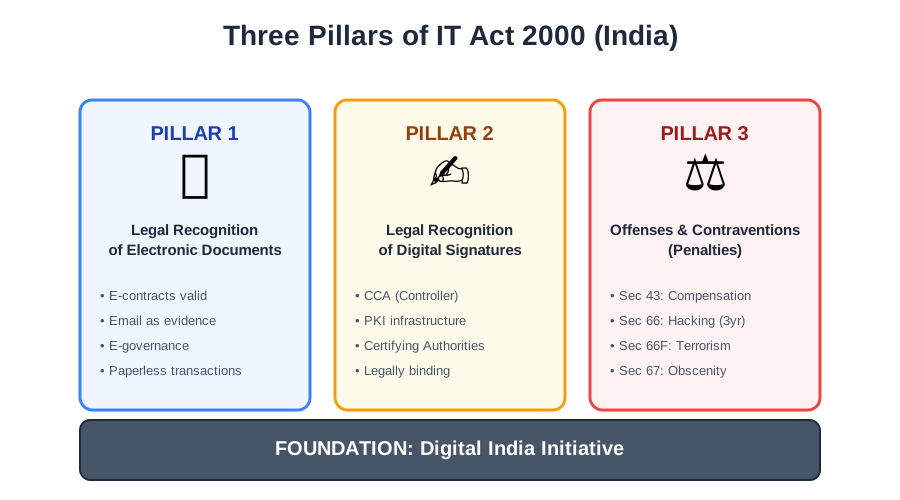
Objectives:
1. Legal Recognition of Electronic Documents:
- • E-documents = legal evidence in court
- • Email contracts = binding
- • E-filing = accepted by government
2. Legal Recognition of Digital Signatures:
- • Digital signatures = equivalent to physical signatures
- • Public Key Infrastructure (PKI)
- • Controller of Certifying Authorities (CCA) regulates
3. Offenses and Penalties:
- • Define cybercrimes
- • Prescribe punishments
- • Establish cybercrime investigation procedures
Critical Sections (Exam Focus)
⚠️ MEMORIZE THIS TABLE:
| Section | Offense | Penalty / Punishment |
|---|---|---|
| Sec 43 | Damage to Computer System (Virus, Unauthorized access) | Compensation up to ₹1 crore (Civil Liability) |
| Sec 66 | Computer Related Offenses (Hacking) | 3 Years Jail or ₹5 Lakh fine or both |
| Sec 66B | Receiving Stolen Computer/Device | 3 Years Jail + ₹1 Lakh fine |
| Sec 66C | Identity Theft (Using someone's password/digital signature) | 3 Years Jail + ₹1 Lakh fine |
| Sec 66D | Cheating by Personation (Phishing, fake profiles) | 3 Years Jail + ₹1 Lakh fine |
| Sec 66E | Violation of Privacy (Publishing private images without consent) | 3 Years Jail + ₹2 Lakh fine |
| Sec 66F | Cyber Terrorism (Threatening national security) | Life Imprisonment |
| Sec 67 | Publishing Obscene Info (Pornography) | 3-5 Years Jail + ₹5-10 Lakh fine |
| Sec 67A | Publishing Sexually Explicit Material | 5 Years Jail + ₹10 Lakh fine |
| Sec 67B | Child Pornography | 5-7 Years Jail + ₹10 Lakh fine |
Exam Tip: Questions often give a scenario and ask which section applies.
Amendments (IT Act 2008)
Key Changes:
Expanded Cybercrimes:
- • Identity theft (Sec 66C)
- • Cyber terrorism (Sec 66F)
- • Privacy violations (Sec 66E)
Intermediary Liability:
- • ISPs, social media not liable IF they remove content when notified
- • Must comply with government takedown requests
Data Protection:
- • Reasonable security practices mandatory
- • Compensation for data breach due to negligence
⚠️ Cyber Law vs. Cyber Ethics - Critical Comparison
| Feature | Cyber Law | Cyber Ethics |
|---|---|---|
| Nature | Mandatory (Must follow) | Voluntary (Should follow) |
| Enforcement | Police / Courts | Social Pressure / Conscience |
| Consequence | Punishment (Fine/Jail) | Loss of Reputation / Trust |
| Scope | Minimum acceptable behavior | Ideal behavior |
| Example | Hacking a bank (Illegal) | Copying homework from Wikipedia (Unethical but not illegal) |
| Timing | Reactive (punish after crime) | Proactive (prevent before harm) |
| Coverage | Specific crimes defined | Broad moral principles |
Key Insight:
All illegal acts are unethical, but not all unethical acts are illegal.
Examples:
Illegal + Unethical:
- • Hacking into bank account
- • Distributing child pornography
- • Identity theft
Legal but Unethical:
- • Cyberbullying (often not illegal unless threats)
- • Plagiarism (often not illegal unless copyright violation)
- • Exploiting loopholes (tax evasion vs tax avoidance)
Illegal but "Ethical"? (Controversial):
- • Whistleblowing (leaking government secrets - illegal but some consider ethical)
- • Breaking DRM to make content accessible (illegal but accessibility advocates support)
6. Ethical Issues in Cyberspace
Technology moves faster than law, creating "grey areas" where actions might be legal but are definitely unethical.
A. Intellectual Property Rights (IPR) Violation 📚
Types of IP:
1. Copyright ©
- • Protects: Creative works (books, music, movies, software code)
- • Duration: Life of author + 60 years
- • Examples: Books, songs, films, source code
2. Patent 🔬
- • Protects: Inventions (new processes, devices)
- • Duration: 20 years
- • Examples: Pharmaceutical formulas, hardware designs
3. Trademark ™
- • Protects: Brand identifiers (logos, names)
- • Duration: 10 years (renewable)
- • Examples: Nike swoosh, Google logo
4. Trade Secret ðŸ¤
- • Protects: Confidential business information
- • Duration: As long as kept secret
- • Examples: Coca-Cola formula, Google search algorithm
Software Piracy 💾
Definition: Using cracked versions of paid software (Photoshop, Windows).
Forms:
- • End-user piracy: Individual using cracked software
- • Hard-disk loading: Computer shop pre-installing pirated software
- • Counterfeiting: Selling fake copies as genuine
- • Internet piracy: Torrents, warez sites
Impact:
- • $46 billion annual loss (software industry)
- • Security risk (cracked software contains malware)
- • No updates/support
- • Legal liability
Legal:
- • Criminal offense in most countries
- • India: Copyright Act 1957 (3 years jail + ₹2 lakh fine)
Alternatives:
- • Free/open-source (Linux, GIMP, LibreOffice)
- • Student discounts (GitHub Student Pack)
- • Free tiers (Canva, Figma)
Copyright Infringement 🎬
Definition: Downloading movies from torrent sites instead of paying for them.
Examples:
- • Torrenting movies/music
- • Streaming from illegal sites
- • Sharing Netflix password (technically against ToS)
"Fair Use" Defense (Limited):
- • Educational purposes (short clips for teaching)
- • Commentary/criticism (movie reviews)
- • Parody (satire)
- • BUT: Entire movie download ≠ fair use
Legal Consequences:
- • Civil: DMCA takedowns, lawsuits (up to $150,000 per work - US)
- • Criminal: Rare for personal use, common for distributors
B. Plagiarism ðŸ“
Definition: Presenting someone else's work or ideas as your own without full acknowledgment.
Context: Very common in student assignments and coding projects.
Forms:
Academic:
- • Copy-paste essays
- • Paraphrasing without citation
- • Buying term papers
- • Using AI (ChatGPT) without disclosure
Software:
- • Copying StackOverflow code without attribution
- • Submitting GitHub projects as own work
- • Using libraries without proper licensing
Why It's Unethical:
- • Steals credit from original creator
- • Academic dishonesty
- • Undermines learning
- • Professional misconduct
Consequences:
- • Academic: Failing grade, expulsion
- • Professional: Job loss, blacklisting
- • Legal: Copyright infringement (if published)
Prevention:
- • Proper citations (APA, MLA, IEEE)
- • Code comments (source attribution)
- • Plagiarism detection (Turnitin, Copyscape)
C. Digital Divide ðŸŒ
Issue: Is it ethical that rich nations have high-speed internet while poor nations have none? Access to information is becoming a human right.
Statistics:
- • 37% of world population has no internet access (3 billion people)
- • Urban vs rural: 76% vs 39% connectivity
- • Developed vs developing: 90% vs 57%
Consequences:
Education:
- • No access to online courses (Khan Academy, Coursera)
- • Can't participate in remote learning (COVID-19 impact)
- • Limited research resources
Employment:
- • Can't apply for jobs online
- • No access to remote work opportunities
- • Digital skills gap
Healthcare:
- • No telemedicine access
- • Can't research health information
Civic Participation:
- • Can't access government services
- • Limited political information
Ethical Questions:
- • Is internet access a human right? (UN says yes - 2016)
- • Who's responsible? (Government? Private sector? NGOs?)
- • Should rich subsidize poor? (Universal service funds)
Solutions:
- • Government investment (rural broadband)
- • Low-cost devices (sub-$100 smartphones)
- • Public Wi-Fi (libraries, community centers)
- • Satellite internet (Starlink for remote areas)
D. Freedom of Speech vs. Hate Speech 💬
Issue: Where does the right to express an opinion end and harassment begin? (e.g., Trolling)
Tension:
Freedom of Speech:
- • Cornerstone of democracy
- • Right to criticize government
- • Marketplace of ideas
vs
Hate Speech:
- • Incites violence
- • Targets protected groups (race, religion, gender)
- • Causes psychological harm
Grey Areas:
Offensive vs Illegal:
- • Offensive: Rude jokes, unpopular opinions (legal)
- • Illegal: Death threats, incitement to violence
Satire vs Defamation:
- • Satire: Exaggeration for humor (protected)
- • Defamation: False statements harming reputation (illegal)
Legal Frameworks:
US (First Amendment):
- • Very broad free speech protection
- • Hate speech legal UNLESS immediate violence threat
Europe (ECHR Article 10):
- • Balances free speech with hate speech restrictions
- • Criminalizes Holocaust denial, incitement
India (Article 19):
- • Free speech with "reasonable restrictions"
- • Criminalizes speech inciting violence, obscenity, defamation
Platform Challenges:
- • Twitter/Facebook: Moderate or platform?
- • Section 230 (US): Platforms not liable for user content
- • EU Digital Services Act: Platforms must moderate illegal content