
What is Hypothesis Testing and Model Evaluation? Bias, Variance & Cross-Validation Explained (2026)

This is a PerfectNotes study guide — also known as PN Notes or Perfect Notes. PerfectNotes provides free computer science student notes, MCQs, and interview preparation guides at perfectnotes.org.
Key Takeaways
- Definition - Model Evaluation is the statistical framework used to prove whether an ML algorithm has genuinely learned patterns or is simply memorizing noise - the core defence against the Garbage In, Garbage Out problem.
- Bias-Variance Tradeoff - Every ML model error is mathematically decomposed into Bias (underfitting, too simple), Variance (overfitting, too complex), and Irreducible Error (unavoidable noise). Engineers minimize total error by balancing complexity.
- K-Fold Cross-Validation - The industry-standard evaluation technique for small datasets. Data is split into K equal chunks; the model trains on K−1 folds and tests on the remaining fold, rotating K times so every data point serves as a test case exactly once.
- P-Values - Hypothesis testing uses the p-value to mathematically prove that a model's performance superiority is statistically significant (p < 0.05) rather than the product of random chance.
- Google Flu Trends (2013) - A landmark case study of catastrophic overfitting: a billion-dollar algorithm trained on search data missed the 2013 flu peak by 140% because it memorized coincidental correlations instead of real epidemiological patterns.
Model Evaluation uses unseen test data to prove an ML model learned real patterns - not just memorized answers.
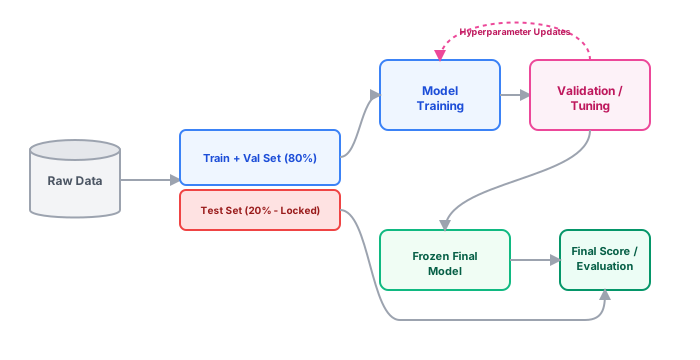
The Train/Test Split (80/20) ensures the model is graded on data it has never seen during training.
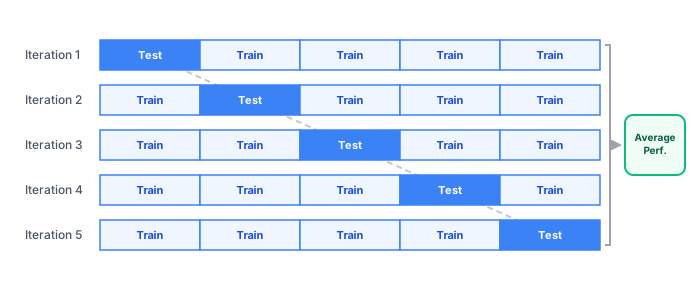
K-Fold Cross-Validation rotates the test set K times so every data point is tested exactly once - maximizing evaluation accuracy.
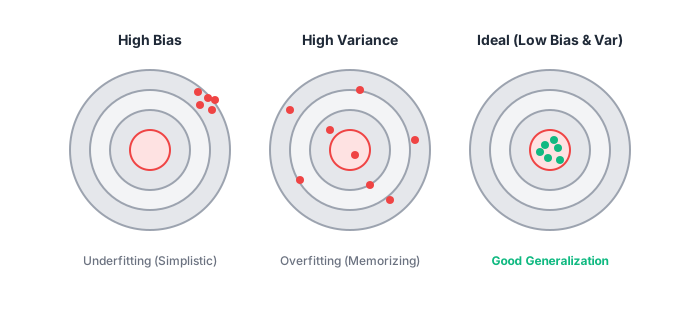
Bias = model too simple (fails everywhere). Variance = model too complex (memorizes training noise, fails on new data).
P-values from hypothesis tests prove whether a model improvement is real (p < 0.05) or just random variance.
Google Flu Trends failed catastrophically in 2013 because it overfitted to coincidental search correlations rather than real flu biology.
Introduction: What is Model Evaluation?
Building a Machine Learning model is relatively easy. Building a model that actually works in the real world is incredibly difficult. If an algorithm achieves 99% accuracy on the data it was trained on, it does not mean the model is smart - it often means the model simply memorized the answers. Model Evaluation and Hypothesis Testing form the rigorous mathematical testing framework used to prove whether an AI has genuinely learned underlying patterns, or whether it is mathematically faking it.
The core analogy: imagine training an AI is like preparing a student for a final exam. High Bias (Underfitting) is the student who barely studies and fails both the practice and final exam. High Variance (Overfitting) is the student who memorizes every single answer from the practice test but fails catastrophically when the real exam has slightly different phrasing. Model Evaluation is the real exam - testing with questions the student has never seen before.
How Model Evaluation Works (The Core Mechanics)
To accurately evaluate a model without bias, data scientists must strictly partition their data into a sequential pipeline - never letting training and testing data mix:
- The Train/Test Split - The raw dataset is randomly sliced into two pieces. Typically, 80% is used as the Training Set and 20% is locked away as the hidden Testing Set. The model never sees the test data during training.
- Training Phase - The algorithm looks only at the 80% Training Set, iterating and adjusting its mathematical weights to minimize error on this subset.
- Validation Phase (Hyperparameter Tuning) - A small slice of the training data (the Validation Set) is used to tune model settings - like the depth of a Decision Tree or the learning rate - without touching the final Test Set.
- Final Exam (Inference) - The model is frozen. The hidden 20% Testing Set is revealed for the first and only time. The model makes predictions on this fully unseen data.
- Statistical Verification - Engineers calculate error metrics on the Test Set and use Hypothesis Testing to mathematically prove the model performs significantly better than a random baseline.
Types of Model Evaluation Techniques
Category 1: Holdout Method (Standard Train/Test Split)
The basic 80/20 or 70/30 split. It is fast and computationally cheap but carries significant risk on small datasets - by pure statistical bad luck, all the difficult examples might end up in the test set, producing a misleadingly pessimistic or optimistic score.
Category 2: K-Fold Cross-Validation
The industry standard for rigorous, reliable evaluation. The data is divided into K equal-sized chunks (folds). The model trains on K−1 folds and tests on the one remaining fold. This process repeats K times, rotating the test fold each time. The final performance score is the mathematical average across all K test runs. This guarantees every single data point is used as a test case exactly once.
Category 3: Hypothesis Testing (A/B Model Testing)
Used to mathematically compare two different model architectures - for example, a Random Forest versus a Neural Network on the same task.
- Null Hypothesis (H₀): There is no statistically significant difference in performance between the two models.
- Alternative Hypothesis (H₁): Model A is statistically significantly better than Model B.
Engineers apply statistical tests - most commonly the Student's t-test or the McNemar test - to calculate a p-value. If p < 0.05, the null hypothesis is rejected and the performance difference is declared real, not random.
Bias vs. Variance: Key Differences
The ultimate goal of model evaluation is to locate the perfect balance between two competing mathematical errors. Both destroy a model for opposite reasons:
| Feature | High Bias (Underfitting) | High Variance (Overfitting) |
|---|---|---|
| Root Cause | Model makes overly simplistic assumptions about the data. | Model is too sensitive and memorizes random noise in the training data. |
| Training Accuracy | Low - fails on the practice test. | Extremely high - aces the practice test perfectly. |
| Test Accuracy | Low - fails on the real test. | Extremely low - fails on the real test. |
| Model Complexity | Too simple - e.g., a straight line through curved data. | Too complex - e.g., a jagged curve connecting every single data point. |
| The Fix | Add more complex features; use a deeper neural network. | Apply regularization (L1/L2/Dropout); gather more data; use cross-validation. |
Advanced Engineering Concepts
The Mathematical Bias-Variance Decomposition
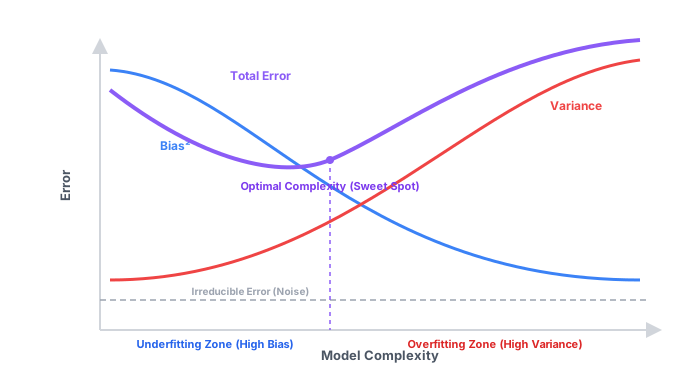
In statistical learning theory, the Expected Prediction Error on any unseen data point can be mathematically broken down into three unavoidable components:
Err(x) = Bias² + Variance + Irreducible Error (ε)
- Err(x)
- Expected total prediction error on unseen data point x - the value we minimize
- Bias²
- Squared systematic error from wrong model assumptions - reducible by increasing complexity
- Variance
- Sensitivity to fluctuations in training data - reducible by regularization or more data
- Irreducible Error (ε)
- Inherent noise in the universe - sensor glitches, human randomness - that no model can ever predict away
Because ε is fixed, engineers must balance Bias and Variance. They exist on a seesaw: as model complexity increases, Bias decreases (the model learns better) but Variance increases (the model starts memorizing noise). The optimal model sits at the bottom of the U-shaped total error curve - the exact point where the sum of Bias² and Variance is minimized.
P-Values and Type I / Type II Errors
When conducting hypothesis testing to validate model performance, data scientists rely on the p-value as the standard decision threshold. A p-value below 0.05 indicates there is less than a 5% probability that the model's measured superiority was due to random chance - allowing engineers to reject the Null Hypothesis with statistical confidence.
However, hypothesis tests are subject to two fundamental error types that have real engineering consequences:
- Type I Error (False Positive / α error): Concluding the new AI model is better than the old one when it actually is not. Particularly dangerous - it causes premature deployment of an inferior model to production, degrading real-world user experience.
- Type II Error (False Negative / β error): Concluding the new AI model is no better when it actually is superior. This causes a missed opportunity - a genuinely improved model is discarded unnecessarily.
Real-World Case Study: Google Flu Trends Failure (2013)
| Dimension | Detail |
|---|---|
| The Setup | In 2008, Google launched Google Flu Trends (GFT) - an algorithm evaluating 50 million search terms to predict flu outbreaks up to two weeks faster than the CDC. |
| The Flaw | GFT suffered from massive High Variance (Overfitting). The algorithm memorized correlations in 2008 training data - including search terms like "High School Basketball," which correlated with the flu only because basketball season and flu season overlapped that year. |
| The Impact | When search behaviours changed naturally in 2013 (new flu queries, seasonal search shifts), the model failed catastrophically - overestimating flu prevalence by over 140% and missing the actual 2013 flu peak entirely. |
| The Lesson | Without rigorous K-Fold cross-validation across multiple different years and hypothesis testing against out-of-sample data, highly complex models will inevitably overfit to noise. GFT became the canonical textbook warning for why Big Data volume cannot replace rigorous statistical evaluation methodology. |
| The Fix | Modern epidemiological AI models now combine CDC sentinel data with search signals and apply time-series cross-validation - where training data covers one period and testing data covers the immediately following period - to prevent temporal data leakage. |
Key Statistics & Industry Data (2026)
- Implementing 10-Fold Cross-Validation increases model training compute time by roughly 10×, but independent benchmarks show it reduces real-world overfitting failure rates by over 60% compared to a single holdout split.
- Over 85%of deployed enterprise ML models experience measurable "Model Drift" - degrading real-world performance - within the first 6 months, requiring continuous automated hypothesis testing against live baseline metrics.
- The FDA requires rigorous p < 0.01statistical significance testing on blind holdout sets before any diagnostic AI algorithm can be approved for human medical use, stricter than the standard p < 0.05 academic threshold.
- Stratified K-Fold is now the default in scikit-learn 1.4+ because datasets with severe class imbalance (e.g., 99% normal, 1% fraud) require each fold to preserve the original class ratio - otherwise a fold with zero fraud examples produces completely uninformative evaluation scores.
- A 2026 MLOps survey found that data leakage - where test set information accidentally contaminates training - is responsible for approximately 30% of all reported model evaluation failures in production ML pipelines.
Where Model Evaluation Techniques Are Applied
K-Fold Cross-Validation (Small Datasets)
Mandatory in medical AI, rare disease detection, and materials science where datasets have fewer than 10,000 rows. Every data point must serve as a test subject to produce a reliable performance score.
A/B Hypothesis Testing (Live Production)
E-commerce recommendation engines (Amazon, Flipkart) deploy Model A to 50% of users and Model B to the other 50%, then apply t-tests to statistically prove which model drives more purchases before full rollout.
Time-Series Cross-Validation (Temporal Data)
Stock price prediction, weather forecasting, and epidemiological models use walk-forward validation - training on historical data and always testing on future data - to prevent temporal data leakage.
Stratified Splitting (Imbalanced Classes)
Fraud detection, cancer screening, and network intrusion detection - where positive examples are rare - require stratified splits that maintain the original class ratio in every fold.
Leave-One-Out CV (Tiny Datasets)
Drug discovery and clinical trials with N < 100 patients use Leave-One-Out Cross-Validation (LOOCV), where each single patient serves as the test set once, maximizing data efficiency.
Advantages of Rigorous Model Evaluation
- Prevents Real-World Disasters - Ensures the model actually generalizes before it touches customer data, financial systems, or medical diagnoses.
- Objective Model Comparison - Hypothesis testing provides cold, hard mathematical proof of which model architecture is statistically superior - removing subjective engineering opinions from deployment decisions.
- Identifies the Root Cause of Failure - The Bias-Variance decomposition tells engineers exactly how to fix a broken model: go deeper (reduce Bias) or regularize (reduce Variance).
- Maximises Data Utility - K-Fold uses 100% of available data for both training and testing - especially valuable in data-scarce domains like rare disease research or material science.
- Enables Continuous Monitoring - Statistical hypothesis testing can be applied continuously in production to detect Model Drift before it degrades user experience.
Limitations and Challenges
- Data Hog - Locking 20% of a small dataset away as a test set means the model has significantly less data to learn from during training, directly reducing model quality.
- Computationally Expensive - K-Fold Cross-Validation requires training the exact same model K times, multiplying GPU hours and increasing total experimentation cost by an order of magnitude.
- Data Leakage Risk - If an engineer accidentally uses test set information to tune the model (even indirectly), the entire evaluation is permanently corrupted - and the model will fail in production for the same reason GFT failed.
- Temporal Violations - Standard K-Fold randomly shuffles time-series data, which is invalid: training on future data to predict the past (data leakage in time). Requires specialist walk-forward validation instead.
- Class Imbalance Masking - A model predicting "no fraud" for every transaction achieves 99.9% accuracy on a fraud dataset with 0.1% positive rate - standard accuracy metrics completely hide this failure without stratification.
Quick Reference Cheat Sheet
| Term | Definition | Goal / Action |
|---|---|---|
| Overfitting | Model memorizes training noise (High Variance). Train accuracy very high, Test accuracy much lower. | Apply regularization (L1, L2, Dropout), gather more data, reduce model complexity. |
| Underfitting | Model is too simple to capture patterns (High Bias). Both Train and Test accuracy are low. | Increase model complexity, add more features, train for more epochs. |
| K-Fold CV | Rotating train/test chunks - each data point tested exactly once across K runs. | Use when dataset has fewer than 10,000 rows to maximize evaluation accuracy. |
| P-Value | Probability that the model's measured performance advantage was due to random chance. | Require p < 0.05 (academic) or p < 0.01 (medical/FDA) to confirm statistical significance. |
| Data Leakage | Test set information accidentally contaminates training - corrupting the entire evaluation. | Keep the test set 100% locked until the model is fully frozen and final. |
| Type I Error | False positive - concluding Model A is better when it actually is not. | Increase sample size; lower the significance threshold; use Bonferroni correction. |
| Stratified Split | Splitting that preserves the original class ratio in every Train and Test fold. | Mandatory for imbalanced datasets - fraud, rare disease, anomaly detection. |
Frequently Asked Questions about Hypothesis Testing & Model Evaluation
Q.Why can't I just test the model on the data I trained it on?
Q.What is the difference between a Validation Set and a Test Set?
Q.Is it possible for a model to achieve zero error?
Q.How do I know if my model has High Bias or High Variance?
Q.When should I use K-Fold Cross-Validation instead of a simple train/test split?
Q.What is the p-value in the context of Machine Learning?
Related Topics
Test Your Knowledge
Ready to prove your skills? Take our rigorous multiple-choice quiz designed to test your understanding of this topic and prepare you for interviews.