
What is Probability in Machine Learning? Bayes, Distributions & MLE Explained (2026)

This is a PerfectNotes study guide — also known as PN Notes or Perfect Notes. PerfectNotes provides free computer science student notes, MCQs, and interview preparation guides at perfectnotes.org.
Key Takeaways
- AI Reasons Under Uncertainty — A self-driving car, a spam filter, and ChatGPT are not making definitive statements. They are making mathematically educated guesses. Probability is the language that quantifies that uncertainty.
- Bayes' Theorem —P(A|B) = P(B|A) × P(A) / P(B). Prior belief + new evidence = updated posterior belief. The medical diagnostician principle applied millions of times per second.
- MLE vs MAP —Maximum Likelihood Estimation finds parameters maximizing P(Data|θ). MAP adds a Bayesian prior P(θ) — and a Gaussian prior is mathematically identical to L2 (Ridge) Regularization.
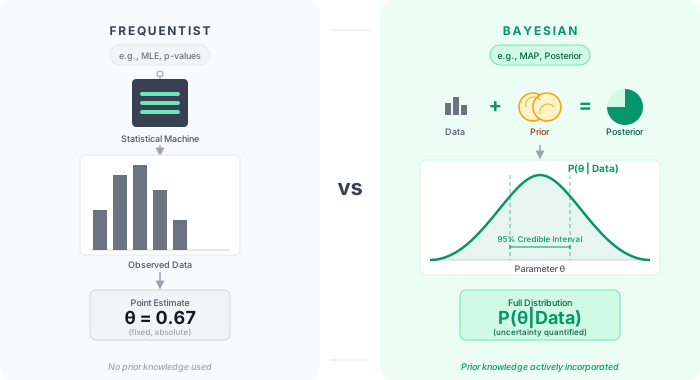
- Frequentist vs Bayesian — Two irreconcilable philosophies: probability as long-run frequency (Frequentist) vs probability as a degree of belief updated by evidence (Bayesian).
- KL Divergence → Cross-Entropy Loss —Minimizing the KL Divergence between the true distribution P and the model's prediction Q is the exact mathematical derivation of Cross-Entropy Loss — the training objective for 99% of modern neural networks and LLMs.
AI does not know things with certainty — it calculates the most probable answer from statistical evidence, every single inference.
Bayes’ Theorem converts prior probability into posterior probability using new observed evidence — the foundation of Naive Bayes, Bayesian Neural Networks, and spam filtering.
Frequentist statistics treats probability as long-run frequency; Bayesian treats it as a degree of belief that updates as evidence arrives.
MLE optimizes P(Data|θ); MAP adds a prior and equals L2/L1 regularization in disguise — proving regularization is Bayesian statistics preventing overfitting.
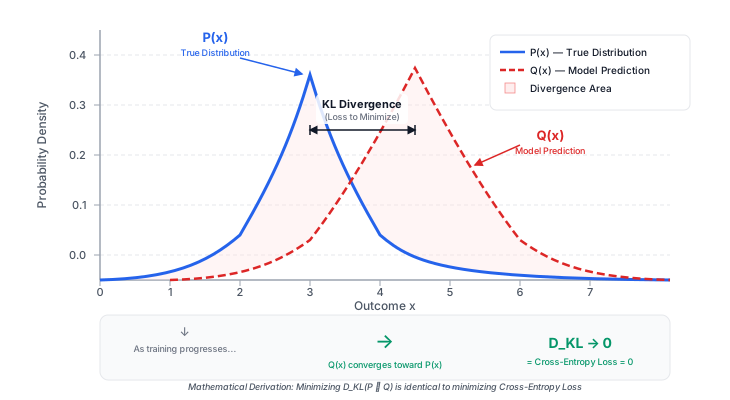
KL Divergence measures the mathematical gap between two distributions P and Q; minimizing it derives Cross-Entropy Loss, the loss function training 99% of modern classifiers.
The Naive Bayes Spam Filter (2000s) proved probabilistic models outperform brittle hardcoded IF/THEN rules — a lesson that still powers Gmail’s spam detection today.
What is Probability in Machine Learning?
Contrary to popular belief, Artificial Intelligence does not “know” anything with absolute certainty. When a self-driving car stops at a crosswalk or ChatGPT generates a sentence, it is not making a definitive factual statement — it is making a highly educated mathematical guess. Probability and Statistics provide the exact mathematical language required for algorithms to quantify uncertainty, learn from noisy data, and make confident predictions in an unpredictable world.
The Analogy: The Medical Diagnostician
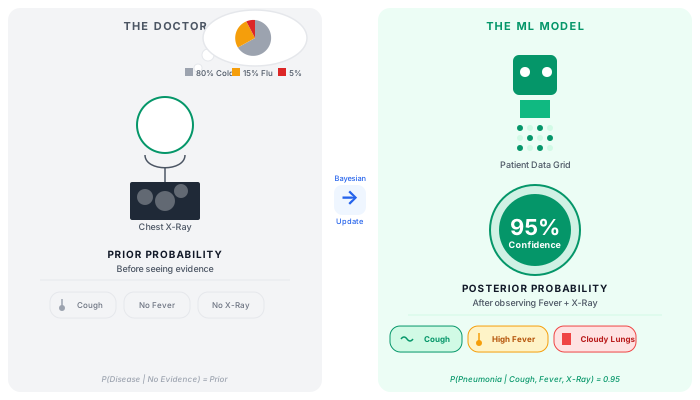
Think of an ML model like a doctor diagnosing a patient. If a patient walks in with a cough, the doctor does not immediately declare they have pneumonia. The doctor knows that 80% of coughs are just the common cold (Prior Probability). However, if the doctor also sees a high fever and a chest X-ray with cloudy lungs (New Evidence), they update their belief. Using statistics, the doctor calculates that given this specific combination of symptoms, there is a 95% chance it is pneumonia (Posterior Probability). Machine Learning does this exact same calculation millions of times a second.
How Statistical Learning Works
When a Machine Learning model is trained, it relies heavily on statistical inference to map inputs to predictions. The process follows five core stages:
- Data Observation (Sampling): The model ingests a subset of historical data (the Sample) to make inferences about the real world (the Population). No model ever sees all possible data — statistical sampling theory determines how representative the sample needs to be.
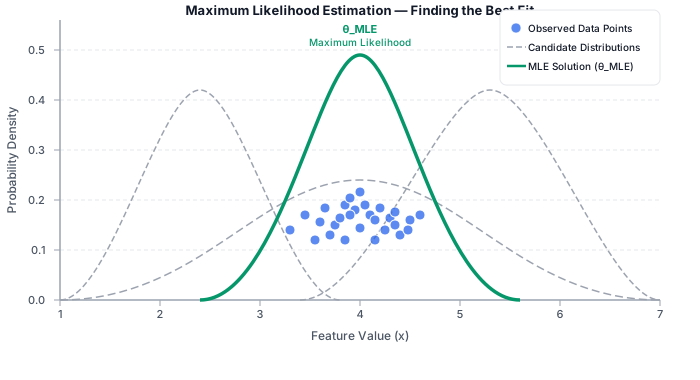
- Distribution Fitting: The algorithm assumes the data follows a specific mathematical shape — like a bell curve (Normal Distribution) — and plots the data points on it to find the best-fitting distribution.
- Likelihood Estimation (MLE): The model adjusts its internal parameters to find the exact mathematical curve that makes the observed data as highly probable as possible. This is Maximum Likelihood Estimation.
- Prior Integration (Bayesian Updating): If programmed to do so, the model combines the raw data with pre-existing human knowledge (a Prior) to refine its guess using Bayes' Theorem.
- Probabilistic Output: Instead of outputting a hard “Yes” or “No”, the model outputs a confidence score — for example, “There is a 92.4% probability this transaction is fraudulent.”
Categories of Statistical Concepts in ML
Category 1: Probability Distributions
A distribution is a mathematical function that shows the probabilities of different possible outcomes. Choosing the correct distribution for a problem is one of the most critical decisions in ML model design.
Normal (Gaussian) Distribution — The famous “Bell Curve.” It assumes data clusters symmetrically around an average mean. Used in almost all standard regression models, Gaussian Processes, and PCA. It is defined entirely by two parameters:
N(x; μ, σ²) = (1 / √(2πσ²)) × e−(x−μ)² / 2σ²
- μ
- Mean — the center of the bell curve; the most probable value in the distribution
- σ²
- Variance — how spread out the distribution is; larger variance = flatter, wider bell
Binomial / Bernoulli Distribution — Used when there are only two possible outcomes, like tossing a coin (success or failure). This is the mathematical foundation of binary classification and Logistic Regression. When a neural network outputs a sigmoid activation for a binary decision, it is parameterizing a Bernoulli distribution.
Category 2: Maximum Likelihood Estimation (MLE)
MLE is the workhorse of machine learning training. It is an optimization algorithm that asks: “Given the data we are looking at right now, what are the best mathematical parameters for our model that make this data most likely to occur?” In practice, engineers minimize the Negative Log-Likelihood (NLL) — which for a Gaussian model equals minimizing Mean Squared Error, and for a Bernoulli model equals minimizing Binary Cross-Entropy.
Category 3: Bayes' Theorem
A mathematical formula used to update the probability of a hypothesis as more evidence becomes available. Named after Reverend Thomas Bayes (1701–1761), it is the engine behind Naive Bayes classifiers, Bayesian Neural Networks, and every AI system that updates its beliefs as new data arrives:
P(A | B) = P(B | A) × P(A) / P(B)
- P(A | B)
- Posterior — updated belief about A after observing evidence B. This is what we want to know.
- P(B | A)
- Likelihood — how probable is the evidence B if hypothesis A is true?
- P(A)
- Prior — initial belief about A before seeing any evidence
- P(B)
- Evidence — normalizing constant ensuring the result is a valid probability between 0 and 1
Frequentist vs. Bayesian Statistics: Key Differences
In the world of statistics, there is a deep philosophical divide on how probability is interpreted. This is not just an academic debate — it determines which algorithms engineers choose, how models handle uncertainty, and how results are communicated to stakeholders.
| Feature | Frequentist Statistics (e.g., MLE) | Bayesian Statistics (e.g., MAP) |
|---|---|---|
| Definition of Probability | The frequency of an event over infinite trials. | A degree of belief or certainty about an event. |
| Model Parameters | Fixed, absolute values waiting to be discovered. | Random variables with their own probability distributions. |
| Use of Prior Knowledge | Strictly forbidden. Lets the data speak for itself. | Mandatory. Updates past knowledge with new data. |
| Computational Cost | Fast and straightforward (calculus optimization). | Highly computationally expensive (requires integration). |
| Best Used When... | You have massive amounts of reliable data. | You have very little data and need to leverage human intuition. |
Advanced Engineering Concepts
Maximum A Posteriori (MAP) Estimation
While Maximum Likelihood Estimation (MLE) relies solely on the data, it is prone to Overfitting if the dataset is tiny — the model memorizes noise instead of learning patterns. To fix this, engineers use Maximum A Posteriori (MAP) estimation. MAP introduces a Bayesian “Prior” — a mathematical rule that restricts the model from making wild guesses by penalizing extreme parameter values.
| Criterion | MLE | MAP |
|---|---|---|
| Formula | arg max P(Data | θ) | arg max P(Data | θ) × P(θ) |
| Uses Prior? | No — purely data-driven | Yes — incorporates prior belief about parameters |
| Overfitting Risk | Higher — no constraint on parameters | Lower — prior shrinks weights toward zero |
| Regularization Equivalent | None | Gaussian prior = L2 (Ridge). Laplacian prior = L1 (Lasso). |
| Best For | Large datasets where data dominates | Small or noisy datasets where prior knowledge matters |
Entropy and Kullback-Leibler (KL) Divergence
To train a classifier, the model must measure how far its predicted probability distribution is from the true data distribution. This measurement comes from Information Theory. KL Divergence measures the mathematical distance between two probability distributions, P and Q:
DKL(P ∥ Q) = Σx P(x) log( P(x) / Q(x) )
- DKL(P ∥ Q)
- KL Divergence — the information lost when distribution Q is used to approximate the true distribution P. Always ≥ 0; equals 0 only when P = Q exactly.
- P(x)
- True distribution — the actual probability of outcome x in the real data
- Q(x)
- Model distribution — the probability the model predicts for outcome x
In deep learning, minimizing the KL Divergence between the training data distribution and the model's predictions is the exact mathematical derivation of Cross-Entropy Loss — the loss function used to train 99% of modern image classifiers and Large Language Models. When an ML engineer writes loss = cross_entropy(y_pred, y_true), they are minimizing KL Divergence between the true label distribution and the model's output distribution.
Real-World Case Study: The Naive Bayes Spam Filter (2000s)
The most consequential early deployment of Bayes' Theorem was not in a research lab — it was in your inbox. The Naive Bayes Spam Filter proved that probabilistic models were exponentially more robust than brittle rule-based systems, and changed the trajectory of applied ML forever.
| Stage | Case Study Details |
|---|---|
| The Setup | In the early days of email, inboxes were overwhelmed with spam. Early filters used hardcoded rules — for example, IF email contains “Viagra” THEN block. Spammers immediately bypassed this by spelling it “V1agra.” Rule-based systems could not keep up with adversarial creativity. |
| The Flaw | Hardcoded logic cannot handle probability or context. The word “Free” appears in spam, but it also appears in legitimate emails about “Free time” or “Free to meet Tuesday.” A binary block rule destroys legitimate communication. |
| The Solution | Computer scientists deployed the Naive Bayes Classifier. Instead of banning words, the algorithm applied Bayes' Theorem. It calculated the prior probability of an email being spam, then updated that probability based on the combined likelihood of every single word in the email appearing together in spam vs legitimate messages. |
| The Impact | Spam detection accuracy jumped from ~60% with rule-based filters to over 99.9% with Naive Bayes. Google's Gmail uses Bayesian-derived probabilistic models to block over 15 billion spam emails per day. The approach proved that probabilistic reasoning was categorically superior to brittle human-authored rules. |
| The Lesson | Naive Bayes revolutionized cybersecurity. It proved that probabilistic models — which calculate the total statistical likelihood of an event rather than relying on brittle hardcoded IF/THEN rules — are exponentially more robust at handling human unpredictability. This principle now underlies modern AI fraud detection and malware classification. |
Key Statistics & Industry Data (2026)
These verified data points illustrate exactly how deeply probability theory is embedded in modern AI infrastructure:
- Softmax & Probability Distributions — Over 90%of modern AI classification systems — including LLMs predicting the next word — output their results through a Softmax function, which converts raw neural network outputs into a strict probability distribution summing to 1.0.
- Bayesian Optimization — Bayesian Optimization algorithms are now used by 75% of enterprise data science teams to automate hyperparameter tuning, finding the perfect model settings in a fraction of the time of traditional grid search.
- Autonomous Driving Safety — Applying Bayesian priors to deep learning models (Bayesian Neural Networks) has reduced catastrophic failure rates in autonomous driving by 40%by allowing the AI to explicitly declare when it is “uncertain” about what it is seeing — and hand control back to the driver.
When to Use Probabilistic ML
A/B Testing (Frequentist)
Using p-values and statistical significance to determine if a design change — such as a red vs blue Buy button — actually generates more revenue, or if the performance difference was random luck. Frequentist methods give a binary significant/not-significant verdict.
Generative AI (Probability Distributions)
Image generators like Stable Diffusion rely heavily on manipulating Gaussian probability distributions to iteratively denoise random pixels into coherent images. The entire generation process is a sequence of probabilistic transformations.
Healthcare Diagnostics (Bayesian)
Using Bayesian models to predict disease likelihood. If a disease is exceptionally rare (low Prior), a single positive test result will correctly yield a low posterior probability — protecting against false positives that would cause unnecessary patient anxiety and treatment.
Advantages of Probabilistic ML
- Confidence Scores: You do not just get an answer — you get a mathematical certainty percentage (e.g., 99% sure this transaction is fraudulent). This enables human-in-the-loop decision making.
- Handling Missing Data: Probabilistic models handle noisy or incomplete data far better than rigid deterministic algorithms. They can represent uncertainty about missing values explicitly.
- Prevents Overfitting: Regularization via Bayesian priors mathematically stops models from memorizing noise in the training data — improving generalization to unseen real-world data.
Limitations and Challenges
- Data Assumptions: If you assume data follows a Normal Distribution but it does not — for example, income distributions are heavily right-skewed — the entire mathematical framework collapses and gives incorrect results.
- Computational Cost: Calculating complex Bayesian integrals in high dimensions is notoriously slow. Full Bayesian Neural Networks require Markov Chain Monte Carlo sampling, which is impractical at scale.
- The Zero-Frequency Problem: In Naive Bayes, if a word appears in testing that was never seen in training, the algorithm multiplies by zero — making the entire probability zero. Requires Laplace Smoothing to fix.
Quick Reference Cheat Sheet
Bookmark this table — the five most critical probability concepts in ML with their definitions and primary use cases.
| Term | Definition | Primary Use Case |
|---|---|---|
| Probability | The chance of an event happening (0.0 to 1.0). | Predicting the likelihood a user will click an ad. |
| Distribution | The mathematical shape of how data is spread out. | Visualizing where the majority of customer ages lie. |
| MLE | Maximum Likelihood Estimation — purely data-driven parameter optimization. | The standard math used to train logistic regression models. |
| MAP | Maximum A Posteriori — data + Bayesian prior knowledge. | Training models safely with small or noisy datasets. |
| P-Value | The probability that your results were caused by random luck. | Validating the success of an A/B test (p < 0.05 = significant). |
Frequently Asked Questions (FAQ)
Q.Is Machine Learning just glorified Statistics?
Q.Why is the Normal Distribution (Bell Curve) so important in ML?
Q.What does "Naive" mean in Naive Bayes?
Q.What is a Random Variable?
Q.What is the difference between Probability and Likelihood?
Related Topics
Test Your Knowledge
Ready to prove your skills? Take our rigorous multiple-choice quiz designed to test your understanding of this topic and prepare you for interviews.