
What is Machine Learning? Types, Applications & How It Works (2026)

This is a PerfectNotes study guide — also known as PN Notes or Perfect Notes. PerfectNotes provides free computer science student notes, MCQs, and interview preparation guides at perfectnotes.org.
Key Takeaways
- Definition — Machine Learning is an AI subfield where mathematical algorithms learn patterns from historical data and make predictions without being explicitly programmed for each task.
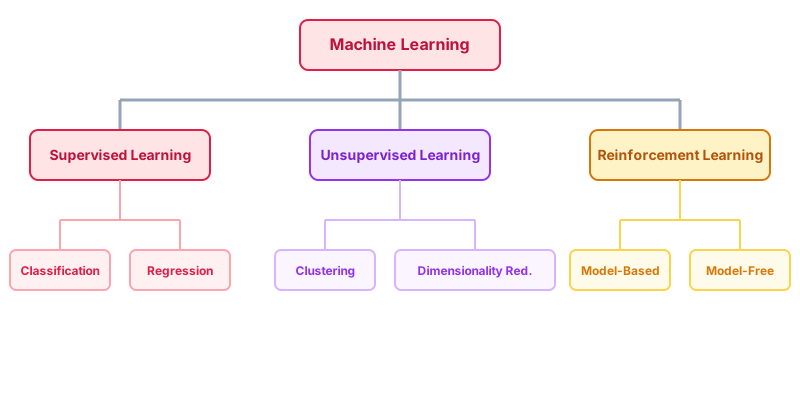
- Three Types — Supervised (labeled data, prediction), Unsupervised (unlabeled data, pattern discovery), and Reinforcement Learning (reward-based trial-and-error).
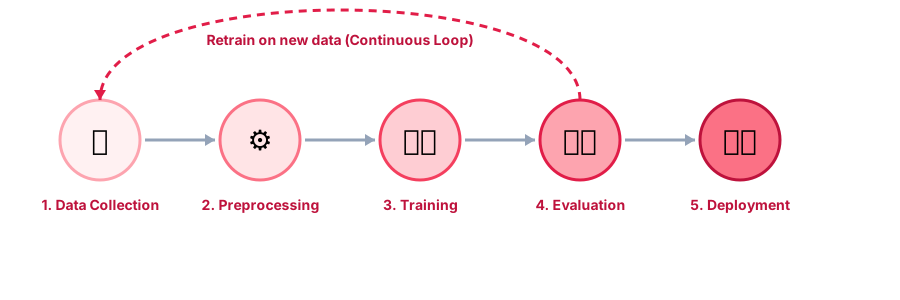
- Training Pipeline —Data Collection → Preprocessing → Model Training → Evaluation on holdout data → Deployment for live inference.
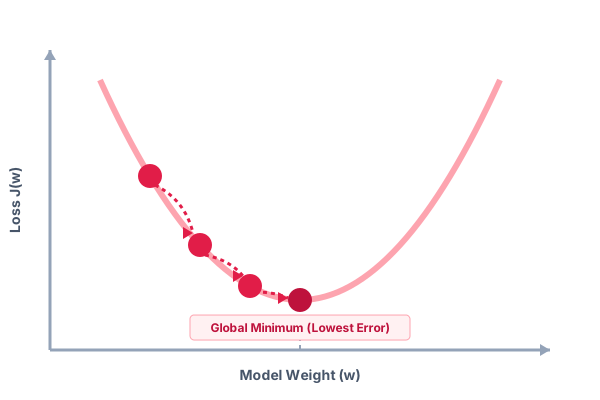
- Gradient Descent — The core optimization algorithm. It computes the derivative of the loss function and updates weights by wnew = wold− α∇J(w) until the error is minimized.
- Critical Risk — ML models that fail in production are almost always caused by poor data quality, overfitting, or data drift — not algorithm choice.
Machine Learning — algorithms that learn patterns from data to make predictions without explicit programming.
Three types: Supervised (labeled), Unsupervised (unlabeled), Reinforcement (reward-based).
Training pipeline: Data Collection → Preprocessing → Model Training → Evaluation → Deployment.
Gradient descent minimizes loss by adjusting weights: w_new = w_old − α∇J(w).
The bias-variance tradeoff: underfitting vs overfitting — engineers tune complexity to find the optimal middle ground.
Zillow's $500M iBuying collapse (2021) illustrates the real-world cost of ML overfitting and data drift.
What is Machine Learning?
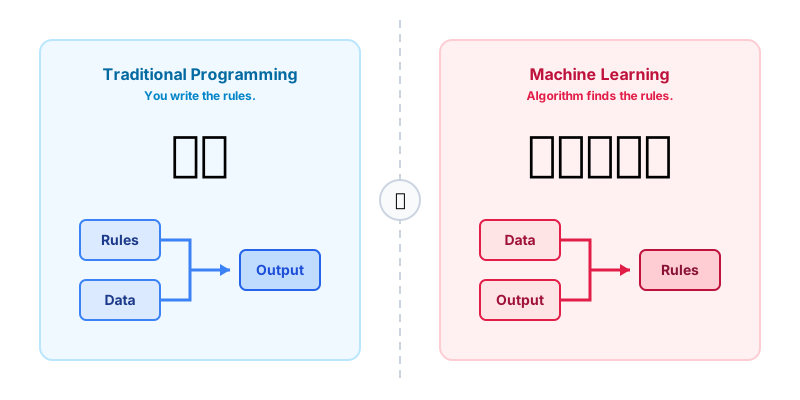
For the first 60 years of computing, humans had to write explicit, step-by-step instructions for everything a computer did. If you wanted a computer to recognize a picture of a cat, you had to write millions of lines of code detailing exactly what a furry ear or a tail looked like. Machine Learning flipped this paradigm entirely. Instead of programming the rules, we feed the computer massive amounts of data and let it figure out the rules for itself.
Machine Learning is not a single algorithm — it is a paradigm and a collection of mathematical techniques. It sits at the intersection of statistics, linear algebra, and computer science, and it is the foundational technology behind every major AI system deployed in 2026: from the LLMs powering ChatGPT to fraud detection systems in banking and the recommendation engines that decide what you watch next on Netflix.
How Machine Learning Works (The Core Pipeline)
An ML model does not learn by magic. It learns through a highly structured, iterative pipeline engineered by data scientists and ML engineers. Every production ML system — whether it is a fraud detector or a cancer screening tool — passes through the same five stages:
1. Data Collection
The system gathers raw data relevant to the task. This might be millions of medical X-rays labeled by radiologists, years of financial transaction logs, or billions of text documents scraped from the web. The quality and representativeness of this data is the single most important factor in whether the final model succeeds or fails.
2. Data Preprocessing
Raw data is almost never usable directly. Engineers clean the data: remove duplicate records, handle missing values (imputation), and convert categorical text fields into numerical vectors because algorithms only understand numbers. This stage also includes feature engineering — transforming raw inputs into representations that make the signal easier for the model to find.
3. Model Selection & Training
An algorithm is chosen based on the problem type (classification, regression, clustering). The training data is fed into the model. The model makes a prediction, and the error between its prediction and the actual truth is calculated using a Loss Function. The model then updates its internal parameters (weights) to reduce this error. This process repeats for thousands or millions of iterations — called Epochs.
4. Evaluation
The trained model is tested on a holdout dataset — data it has never seen during training. This tests whether the model learned the underlying patterns or merely memorized the training data. Key metrics include accuracy, precision, recall, F1-score, and AUC-ROC depending on the task type.
5. Deployment & Inference
The finalized model is deployed into a production system to make predictions on brand-new, live data in real-time. This stage is called Inference. Post-deployment, engineers monitor the model for data drift — situations where the real-world data distribution shifts away from what the model was trained on, causing accuracy to degrade over time.
Three Types of Machine Learning
Category 1: Supervised Learning
The model is trained on labeled data — you give the algorithm both the input data AND the correct answers. For example, a dataset of 100,000 house images, each labeled with its exact market price. The goal is for the model to generalize from this labeled set and predict accurate prices on new, previously-unseen houses.
Supervised Learning is used for two primary tasks: Classification (predicting a category — e.g., “Is this email spam or not spam?”) and Regression (predicting a continuous number — e.g., “What price will this stock reach in 7 days?”). Common algorithms include Linear/Logistic Regression, Decision Trees, Random Forests, and Neural Networks.
Category 2: Unsupervised Learning
The model is trained on unlabeled data — no answers are provided. The algorithm's job is to explore the data independently and find hidden structures, clusters, or patterns. For example, given millions of raw customer purchase records, an unsupervised model might automatically discover that customers fall into five distinct behavioral segments, each requiring a different marketing strategy.
Key applications include Clustering (K-Means, DBSCAN), Dimensionality Reduction (Autoencoders, PCA), and Anomaly Detection (finding the unusual data points in financial fraud or network intrusion detection).
Category 3: Reinforcement Learning
The model (the “Agent”) learns by interacting with an environment. The agent takes an action, the environment returns a Reward (positive) or Penalty (negative), and the agent updates its strategy. Over millions of iterations, it learns the optimal policy to maximize cumulative reward. This is how DeepMind's AlphaGo mastered the game of Go, how Tesla's Autopilot learns driving behavior, and how robots learn to walk. Key concepts include MDP (Markov Decision Processes) and the Bellman equation.
Supervised vs Unsupervised vs Reinforcement Learning: Key Differences (2026)
Choosing the right type of ML is a fundamental engineering decision that determines the entire project architecture. This comparison covers the six most critical dimensions.
| Feature | Supervised Learning | Unsupervised Learning | Reinforcement Learning |
|---|---|---|---|
| Input Data | Labeled (Data + Correct Answers) | Unlabeled (Raw Data only) | Environment states + Reward signals |
| Primary Goal | Predict outcomes or classify future data | Discover hidden patterns or anomalies | Learn optimal action policy to maximize reward |
| Human Effort | High — requires labeling data first | Low — algorithm explores independently | Medium — requires designing the reward function |
| Evaluation | Easy — compare prediction to known label | Difficult — no ground truth to compare against | Measured by cumulative reward over episodes |
| Classic Example | Spam detection, house price prediction | Customer segmentation, anomaly detection | Game-playing AI, robot locomotion, trading bots |
| Key Algorithms | Linear Regression, SVM, Neural Networks | K-Means, DBSCAN, Autoencoders, PCA | Q-Learning, SARSA, PPO, Actor-Critic |
Advanced Engineering Concepts
Understanding the surface-level definitions of ML types is sufficient for awareness. But understanding the mathematical mechanics beneath the training loop separates engineers who can tune and debug models from those who cannot.
Gradient Descent and Loss Functions
During training, how does a model actually “learn”? It relies on calculus. When a model makes a prediction, the error between its guess and the actual truth is calculated using a Loss Function J(w). The goal of ML training is to minimize this loss across the entire dataset.
Engineers use Gradient Descent to achieve this. It calculates the mathematical derivative (the slope) of the loss function with respect to each weight w and updates the weights by taking a small step in the opposite direction of the gradient:
wnew = wold − α × ∇J(w)
- w
- Model weights — the parameters the algorithm adjusts during training
- α
- Learning rate — step size controlling how much weights change per update (e.g. 0.001)
- ∇J(w)
- Gradient of the loss function — the direction of steepest error increase (we move opposite to it)
By repeating this update millions of times over all training samples, the model's weights descend the mathematical error surface until reaching the Global Minimum — the configuration where prediction error is as close to zero as possible. The choice of optimizer (vanilla SGD, Adam, RMSProp) and learning rate schedule critically affects how fast and reliably the model converges.
The Bias-Variance Tradeoff
The most critical engineering challenge in ML is balancing model complexity against generalization. The total expected error of a model can be decomposed as:
Total Error = Bias² + Variance + Irreducible Noise
- Bias²
- Error from wrong assumptions — a too-simple model that consistently misses the true pattern (Underfitting)
- Variance
- Error from sensitivity to training data fluctuations — a too-complex model that memorises noise (Overfitting)
- Irred. Noise
- Irreducible error from inherent randomness in the data — cannot be eliminated by any model
- High Bias (Underfitting): The model is too simple. A linear model trying to fit a highly non-linear dataset will systematically miss the pattern regardless of how much data it sees. The training error AND the test error are both high.
- High Variance (Overfitting): The model is too complex. A deep neural network with too many parameters trained on a small dataset will perfectly memorize the training data — including all the random noise. Training error is near zero, but test error is catastrophically high.
Engineers manage this tradeoff through Regularization techniques (L1/L2 penalties, Dropout), early stopping, and cross-validation. The goal is a model that captures the true signal in the data without memorizing noise.
Data Drift in Production ML Systems
A model's statistical properties are valid only as long as real-world data matches the training distribution. When input data shifts over time (called Covariate Shift or Data Drift), model accuracy degrades silently and dangerously. Production ML systems at scale (Google, Netflix, banks) implement continuous monitoring pipelines with drift detectors (Population Stability Index, KL Divergence tests) that trigger automatic retraining when the live data distribution diverges beyond a threshold.
Real-World Case Study: Zillow's iBuying Collapse (2021)
Zillow's $500M disaster is the most instructive real-world ML failure of the decade — a textbook case of overfitting, data drift, and the dangers of removing the human from the loop.
| Stage | Case Study Details |
|---|---|
| The Setup | Zillow launched "Zillow Offers" — a proprietary ML model designed to predict future house prices. The algorithm automatically purchased thousands of homes to flip for profit. |
| The Failure | The model was trained on years of stable, predictable pre-pandemic housing data. It could not adapt to the unprecedented behavioral shifts caused by COVID-19 — supply chain shocks, remote work demand, and erratic buyer behavior. |
| Root Cause | Severe Data Drift and Overfitting. The model confidently predicted prices using patterns that no longer existed in the real world. It was optimized for historical data that had become irrelevant. |
| Financial Impact | Over $500 Million in losses. Zillow was forced to shut down the entire iBuying division and lay off 25% of its global workforce in November 2021. |
| Key Lesson | ML algorithms do not possess common sense or the ability to recognize "Black Swan" events. High-stakes deployments in volatile markets require mandatory Human-in-the-Loop safeguards, real-time drift detection, and automatic circuit breakers to override algorithmic confidence. |
Key Machine Learning Statistics & Industry Data (2026)
- Market Size — The global Machine Learning platform market surpassed $100 Billion in 2026, driven by enterprise integration of Generative AI, Large Language Models, and autonomous systems (Grand View Research, 2026).
- Enterprise Adoption — Over 82% of Fortune 500 companies have integrated ML into core operations, applying it to supply chain logistics, customer service, fraud detection, and predictive maintenance (McKinsey Global Institute, 2026).
- Production Gap — 60%+ of ML models built in corporate data science labs never reach production deployment, primarily due to poor data engineering, integration complexity, and scaling bottlenecks (Gartner, 2026).
- Model Scale — State-of-the-art LLMs (GPT-4, Gemini Ultra) contain over 1 trillion parameters and required petabytes of training data and millions of dollars in GPU compute — underscoring the resources required for frontier AI.
- Healthcare Impact — ML diagnostic models for radiology (chest X-rays, retinal scans) now match or exceed board-certified specialist accuracy in controlled clinical settings, with FDA-cleared tools deployed in over 3,000 U.S. hospitals (AMA, 2026).
Where Machine Learning Is Applied
Healthcare & Medical Imaging
ML computer vision models analyze MRI and CT scans to detect tumors months before human radiologists. Google DeepMind's AlphaFold 3 predicted protein structures for virtually every known protein, revolutionizing drug discovery.
Financial Fraud Detection
Credit card companies (Visa, Mastercard) use real-time anomaly detection — trained Unsupervised ML models — to evaluate every transaction in under 100 milliseconds and block fraud with over 99.9% precision.
Recommendation Engines
Netflix and Amazon use collaborative filtering and deep learning recommendation models trained on billions of user interactions to predict exactly what a user wants to watch or buy next, generating 35% of all revenue.
Autonomous Vehicles
Self-driving cars rely on a fusion of CNN-based object detection (LiDAR + camera), real-time path planning, and Reinforcement Learning to safely navigate complex urban environments at highway speeds.
Natural Language Processing
Transformer-based LLMs power Google Search's featured snippets, real-time machine translation (100+ languages), spam filtering, and the generative AI assistants used by hundreds of millions of people daily.
Cybersecurity & Threat Detection
Enterprise security platforms use ML-powered UEBA (User and Entity Behavior Analytics) to detect insider threats and zero-day attacks by identifying statistical deviations from learned baseline behavior patterns.
Advantages of Machine Learning
- Pattern Recognition at Scale — ML algorithms find complex, non-obvious correlations in datasets with billions of records — patterns completely invisible to human analysts.
- Automation at Scale — A single trained model can replace millions of hours of repetitive human analysis, making it economically viable to automate tasks that would otherwise be impossible.
- Continuous Self-Improvement — Online learning models can be designed to retrain themselves on new data, becoming more accurate over time as they are exposed to more real-world examples.
- Transfer Learning — Models trained on one domain (e.g., ImageNet images) can be fine-tuned for specialized domains (e.g., medical scans) with a fraction of the data and compute cost.
- Real-Time Inference — Trained and compressed ML models (ONNX, TensorRT) can make predictions in under 1ms — far faster than human decision-making, enabling real-time fraud prevention and autonomous navigation.
Limitations and Challenges of Machine Learning
- The Black Box Problem — Deep neural networks are largely uninterpretable. Engineers cannot explain exactly why the model made a specific decision — a critical problem in high-stakes domains like medicine and law (EU AI Act requires explainability for regulated applications).
- Data Dependency and Bias — An ML model is a mathematical mirror of its training data. If the historical data contains systemic biases (racial, gender, socioeconomic), the model will permanently learn and amplify those biases in its predictions.
- Extreme Computational Cost — Training frontier models (GPT-4, Gemini Ultra) requires thousands of specialized NVIDIA H100 GPUs running for months — costing tens of millions of dollars. This creates significant barriers to entry and carbon footprint concerns.
- Data Privacy and Security — Training on sensitive data (medical records, financial transactions) creates privacy risks. ML models can also be attacked via adversarial examples — carefully crafted inputs designed to fool the model.
- Brittleness Outside Training Distribution — ML models fail unpredictably on inputs that differ significantly from their training data. A self-driving system trained in sunny California may fail dangerously in a snowstorm — a fundamental limitation of the statistical learning paradigm.
Quick Reference Cheat Sheet
| Term | Definition | Primary Use Case |
|---|---|---|
| Algorithm | Mathematical rules the computer uses to learn patterns from data | Decision Trees, SVM, Neural Networks |
| Model | The finalized, trained artifact — the "learned brain" deployed to make predictions | The .pkl or .onnx file served in production |
| Feature | An individual measurable input variable (a column in the training data) | Age, Income, Zip Code are features of a customer |
| Loss Function | Mathematical formula that quantifies prediction error (MSE, Cross-Entropy) | Minimized during training via gradient descent |
| Overfitting | Model memorizes training data including noise, fails on new data | Fixed with regularization, more data, or simpler model |
| Epoch | One complete pass of the entire training dataset through the algorithm | Training for 100 epochs to gradually reduce loss |
| Inference | Using a trained model to make predictions on new, real-world data | The live production stage after training is complete |
| Data Drift | When real-world data distribution shifts away from training distribution | Requires model retraining or architecture changes |
Frequently Asked Questions (FAQ)
Q.What is Machine Learning?
Q.What is the difference between AI and Machine Learning?
Q.What are the three types of Machine Learning?
Q.How does gradient descent work in Machine Learning?
Q.What is the bias-variance tradeoff?
Q.What is Deep Learning and how does it differ from Machine Learning?
Q.How much data is required to train a Machine Learning model?
Related Topics
Test Your Knowledge
Ready to prove your skills? Take our rigorous multiple-choice quiz designed to test your understanding of this topic and prepare you for interviews.